
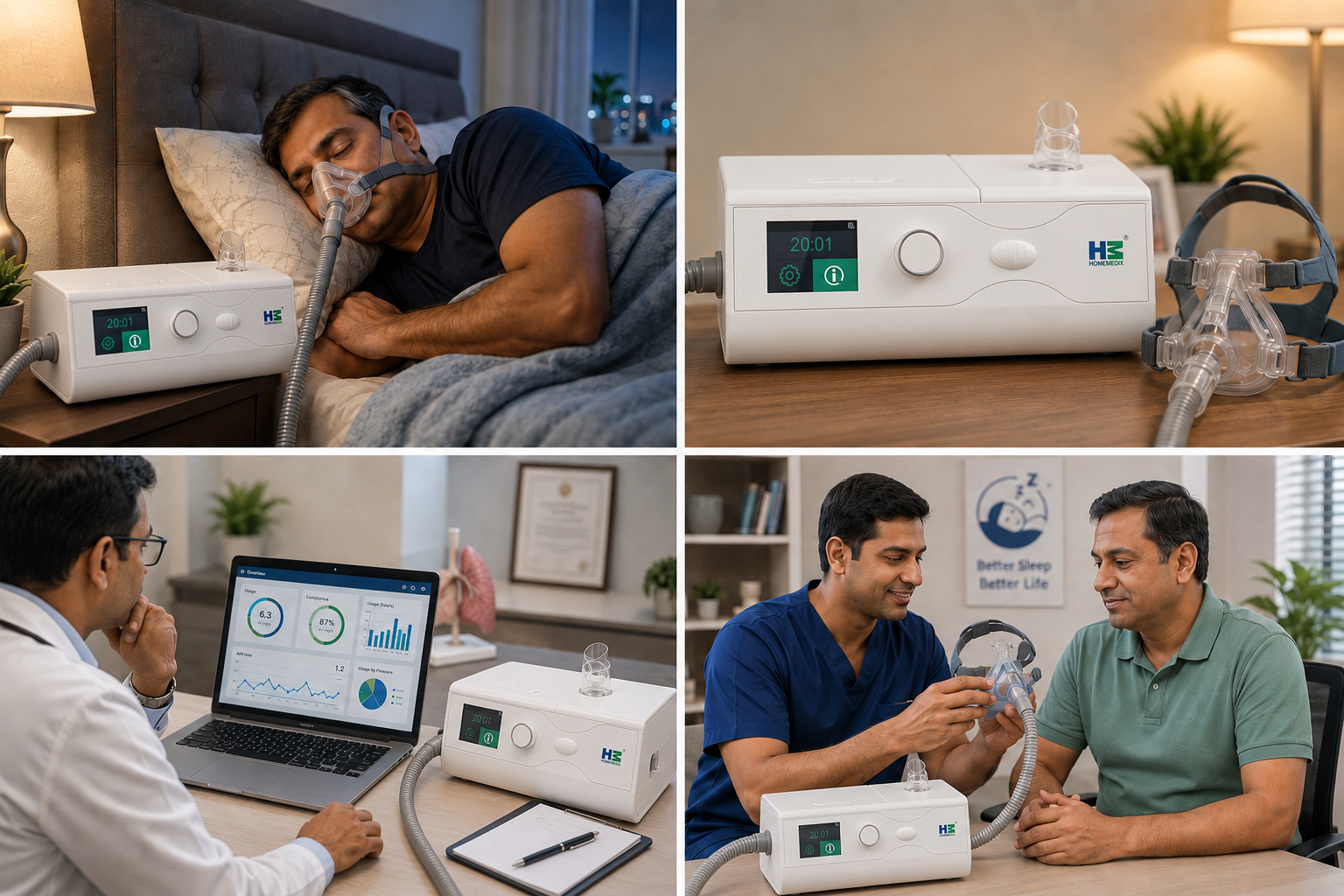
CPAP adherence: the 4-hour threshold, what drives it, and Indian reality
Every CPAP user eventually encounters the number: 4 hours a night, on at least 70% of nights, over a rolling 30-day window. That is the compliance threshold used by insurance schemes internationally, by sleep-medicine quality registries, and — where follow-up happens at all — by clinicians assessing whether to continue, modify, or discontinue CPAP therapy.
The number is simple, but the story behind it is not. In this article, Home Medix India explores where the threshold comes from, what outcome data looks like at different adherence levels, why telehealth coaching improves patient success rates, and what the real-world CPAP compliance picture looks like in Indian practice.
For patients, caregivers, and healthcare professionals, understanding CPAP adherence is critical because consistent therapy directly impacts sleep quality, cardiovascular health, daytime energy, and long-term respiratory wellness.
Where the 4-hour / 70% threshold comes from
The 4-hour/70% rule is not a physiological number. It is an operational number, set by the US Centers for Medicare & Medicaid Services (CMS) in 2008 as a coverage criterion for continued CPAP reimbursement. The underlying logic:
*Early CPAP outcome studies showed a dose-response relationship between CPAP usage and symptom improvement. More usage produced more benefit.
*The largest incremental gains in sleepiness and cognitive metrics appeared in the range of 0 to about 6 hours per night, with diminishing returns above 6 hours CPAP adherence in India
*A threshold was needed for insurance operations. CMS picked 4 hours as a reasonable inflection point — enough usage to expect clinical benefit, achievable by most engaged patients.
*The 70% of nights was a pragmatic concession: demanding 100% would have disqualified many adherent patients dealing with occasional illness, travel, or mask issues.
The number was never meant to be a clinical target. It was meant to be a minimum operational criterion. But because insurance systems operationalised it, clinicians started using it as a shorthand for “adherent,” and the shorthand stuck
What outcome data actually looks like
Published cohort studies with cardiovascular and cognitive endpoints show a graded relationship between usage hours and outcomes:CPAP adherence in India
- 0–1 hour per night: essentially no treatment effect. Patient might as well not own a CPAP.
- 1–3 hours per night: small, partial benefit on sleepiness scores; minimal blood-pressure benefit; no measurable cardiovascular-event-rate reduction.
- 4–6 hours per night: clear sleepiness benefit, measurable blood-pressure reduction (1–3 mmHg on average, larger in resistant hypertension), emerging cardiovascular-event-rate reduction in high-risk populations. (Weaver TE et al, Sleep)
- 6+ hours per night: full symptomatic benefit; the cardiovascular benefit appears plateau-shaped above this.
The key implication: the 4-hour threshold is roughly the floor of meaningful benefit, not the optimum. A patient using CPAP 4.5 hours a night for 70% of nights is accruing partial benefit. A patient using CPAP 7 hours a night for 95% of nights is accruing full benefit. Reporting “the patient is compliant” because they hit the CMS threshold underplays this gradient.CPAP adherence in India
For specific outcomes:
- Daytime sleepiness (Epworth score): responds at relatively low usage. Even 3–4 hours a night produces measurable ESS reduction in many patients.
- Cognitive performance metrics: respond in the 4–6 hour range.
- Systolic blood pressure: responds at ≥ 4 hours with a 2–3 mmHg average reduction; 5–8 mmHg in resistant hypertension.
- Cardiovascular event rate: observational data suggest benefit begins around 4 hours and grows with additional usage; randomised-trial data (SAVE, RICCADSA) showed more modest effects that were heavily influenced by adherence.
- Atrial fibrillation recurrence post-ablation: observational data strongly support adequate CPAP adherence reducing recurrence
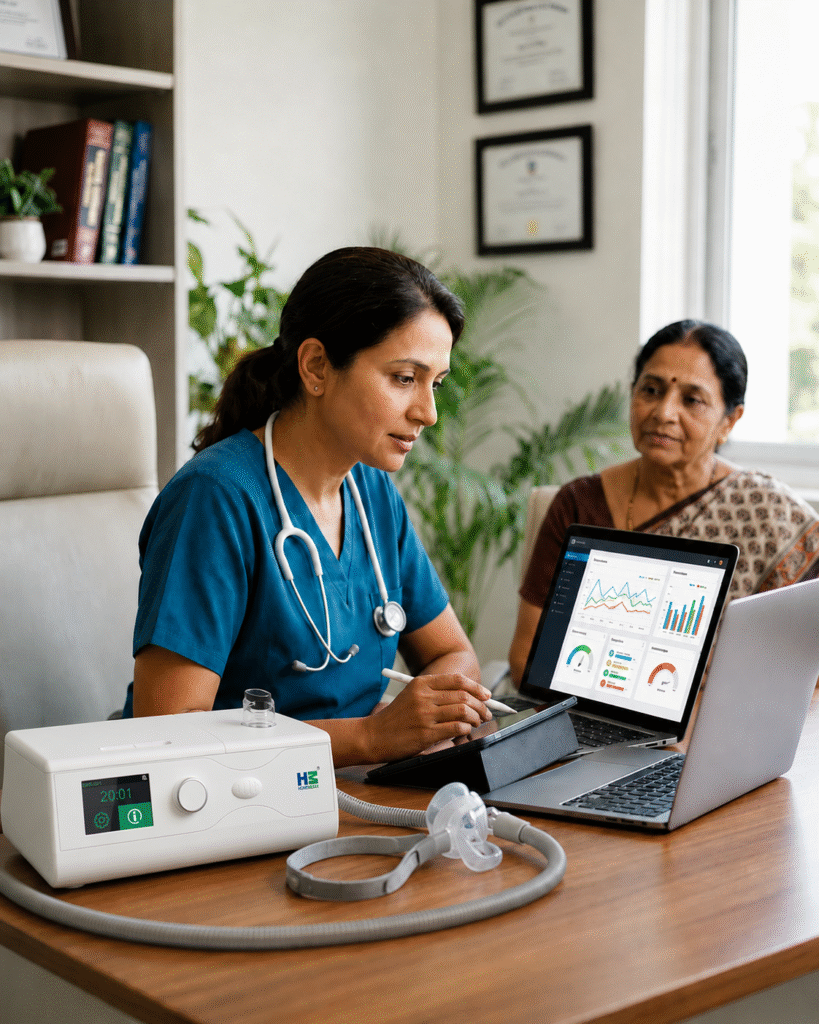
What drives adherence
Adherence is not a patient-personality variable. It is a set of modifiable factors, some device-related, some patient-related, some system-vadherence in India.CPAP adherence in India
Modifiable device factors
- Mask fit. The single largest contributor. A well-fitted mask can mean the difference between 2 hours a night and 7 hours. Mask-fit quality predicts adherence more robustly than any other device variable.
- Humidification. Adequate humidification reduces dry mouth and nasal congestion — both common causes of early therapy abandonment. Heated humidification produces measurably better adherence than ambient-temperature humidification.
- Pressure profile. High CPAP pressures (> 15 cmH₂O) without a bilevel or expiratory pressure relief often drive abandonment. A pressure-sensitive patient may need a BiPAP-S or at minimum an aggressive EPR setting.
- Ramp and auto-start. Gentle pressure initiation via ramp (10–45 minute ramp to therapeutic pressure) helps patients fall asleep without the full pressure on; auto-start ensures therapy is delivered whenever the mask is worn.
- Quiet operation. Adherence drops sharply in patients whose partner complains of noise. Modern CPAPs (ResMed, Philips) run at 26–28 dBA at typical pressures; older or budget devices may be noticeably louder.
Modifiable patient and system factors
- Patient education at initiation. A 30-minute initiation session covering how the device works, why AHI matters, what the report will look like, and what to expect in the first 2 weeks — produces measurable adherence gain. Most Indian initiations skip this and the cost is visible in 30-day adherence data.
- Early follow-up. A phone or in-person check-in at day 7 and day 30 is strongly predictive of adherence at 90 days. Patients abandon CPAP mostly in the first 2 weeks; interventions in that window matter.
- Cognitive behavioural therapy for insomnia (CBT-I) in patients with coexisting insomnia. A significant subset of CPAP dropouts is driven by underlying untreated insomnia that CPAP cannot fix and can worsen.
- Treatment of nasal conditions. Untreated allergic rhinitis, chronic sinusitis, and nasal septal deviation undermine CPAP use. Addressing these materially improves adherence.
Telehealth and cloud-reporting
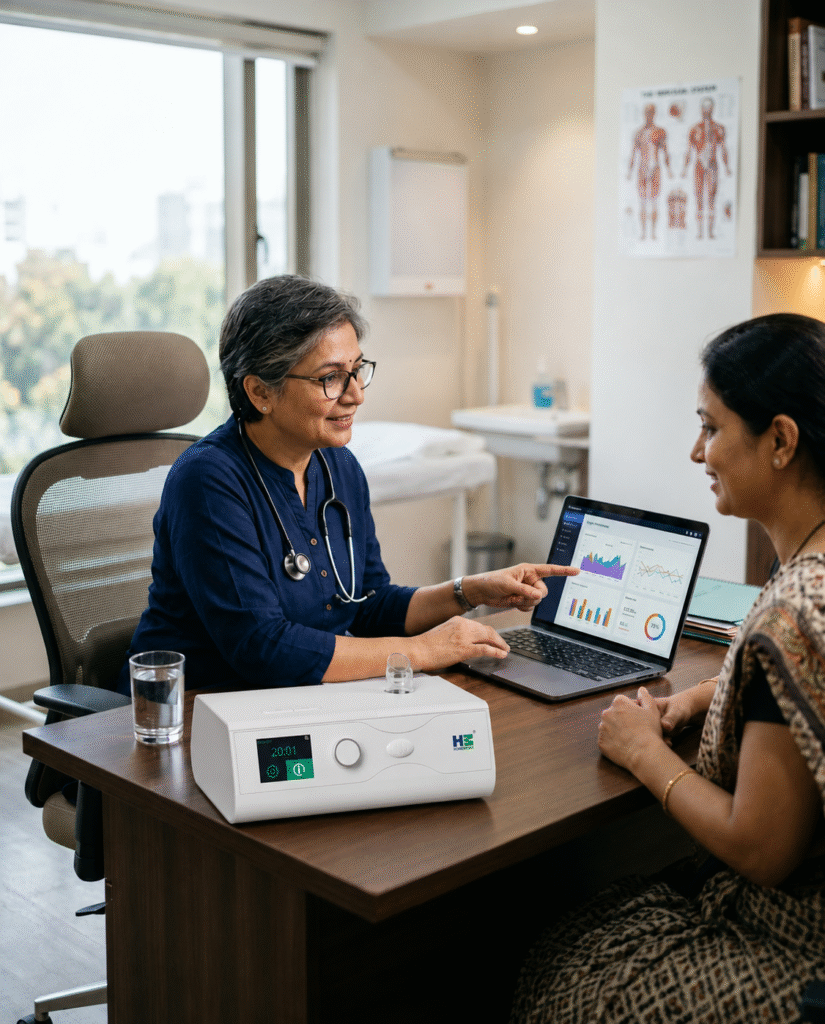
CPAP adherence in India.Cloud-reporting (ResMed AirView, Philips DreamMapper, BMC myAirFit equivalent) allows remote monitoring without a clinic visit. Published data suggest cloud-reporting-enabled interventions produce a 10–15 percentage point improvement in adherence at 90 days, compared to standard follow-up.CPAP adherence in India
The mechanism is not mysterious. When a clinician can see that a patient used CPAP 2.5 hours last night with a high leak reading, they can phone the patient and address the mask fit. Without cloud access, the same issue only surfaces at the next 3-month clinic visit, by which time the patient has abandoned therapy. The value is in the 2-week feedback loop, not in the data itself.
In Indian practice, AirView-style cloud reporting is used inconsistently. Patients with tertiary-centre follow-up and cloud-enabled devices get the benefit. Patients whose distributor supplied a device without configuring the cloud account do not. Asking at purchase whether the cloud account will be set up and monitored is a reasonable ask.CPAP adherence in India
Indian compliance reality
CPAP adherence in India.Real-world Indian CPAP adherence figures, where data are available, are meaningfully below international published averages:
- 30-day adherence (4h/70% threshold): 50–65% of patients. International published averages 65–75%.
- 90-day adherence: 40–55% of patients. International averages 55–70%.
- 1-year continued therapy: 35–50%. International averages 50–65%.
Limited insurance coverage. Most CPAP therapy in India is self-paid. There is no insurance-driven compliance check that operationalises the 4-hour threshold. Patients who struggle in the first month often simply stop, with no systematic follow-up to catch them.
Distributor-driven initiation. Many Indian patients receive their CPAP from an equipment distributor rather than a sleep-medicine clinic. The initiation quality is variable, and the follow-up is usually commercial (a check-in to sell accessories) rather than clinical.
Patchy follow-up infrastructure. Outside tertiary centres, sleep-medicine clinical follow-up is rare. A patient struggling with mask fit at week 3 often has no accessible clinical contact to troubleshoot.
Affordability and “sunk cost” psychology. Patients who paid ₹60,000 for a CPAP may continue using it nominally (1–2 hours a night) so they can feel they are using the investment, without deriving therapeutic benefit.
Travel and electricity reliability. In cities with frequent power cuts, patients whose CPAP cannot run on battery may accept interrupted therapy nights. For patients travelling frequently on work, a travel CPAP (ResMed AirMini, Breas Z2) materially helps continued adherence; most Indian patients do not have one.
What patients (and families) can do
Demand a proper initiation. Insist on a 30-minute session that covers the device, the report, and the first-2-week expectations. If the distributor cannot provide this, ask for a sleep-technician consultation separately.
Mask change early if discomfort persists. Do not spend 8 weeks fighting a mask that does not fit. Change at 2 weeks if the problem is clear. Most distributors in major Indian cities allow mask swaps within the first 30 days.
Engage cloud reporting. Ask for the AirView/DreamMapper account to be configured at purchase, with the clinician’s email enabled. Review the data monthly.
Engage cloud reporting. Ask for the AirView/DreamMapper account to be configured at purchase, with the clinician’s email enabled. Review the data monthly.
Engage cloud reporting. Ask for the AirView/DreamMapper account to be configured at purchase, with the clinician’s email enabled. Review the data monthly.
For clinicians
A sleep clinic running an Indian CPAP service can lift adherence measurably with three process changes:CPAP adherence in India
- A structured 30-day follow-up call or visit, built into the initial sale. One scheduled touchpoint.
- Cloud-reporting configured at initiation with clinician email notifications.
- A documented mask-swap pathway for the first 30 days, executed without friction.
These three interventions, together, have been shown in multiple studies to lift 90-day adherence by 15–25 percentage points compared to no-intervention baseline.CPAP adherence in India.
What does CPAP adherence mean?
The 4-hour CPAP rule means using the machine for at least 4 hours per night on 70% of nights.
What is the 4-hour CPAP rule?
Four hours is only the minimum useful level, while 6 to 7 hours gives better and fuller benefits.
Is 4 hours of CPAP use enough?
Patients often stop using CPAP because of poor mask fit, dry mouth, nasal blockage, pressure
Why do many patients stop using CPAP?
Patients often stop using CPAP because of poor mask fit, dry mouth, nasal blockage, pressure discomfort, or lack of follow-up.
How can CPAP compliance be improved?
CPAP compliance can improve through proper mask fitting, patient education, early follow-up, nasal care, and cloud-based monitoring.