
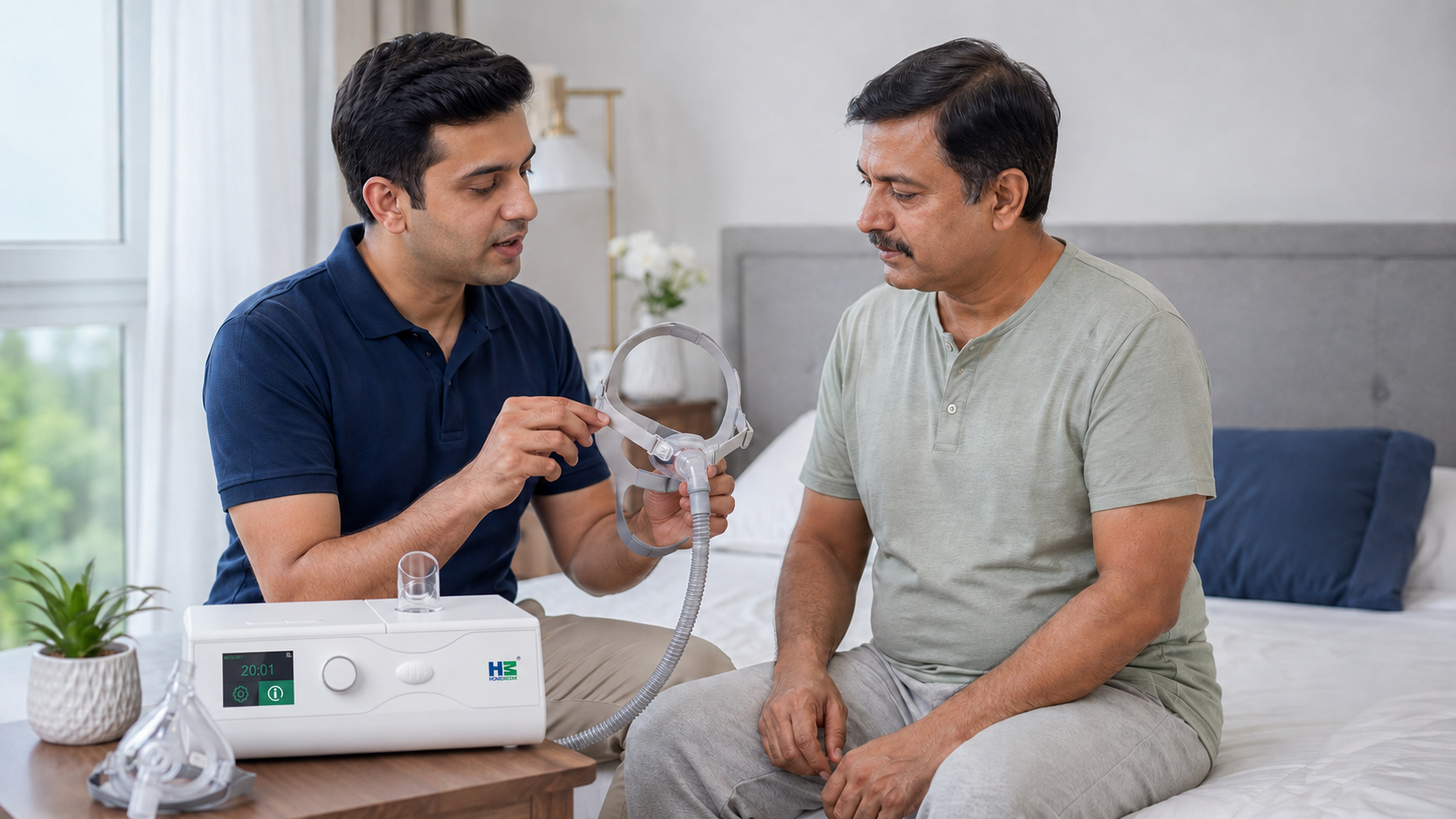
CPAP side effects and management: aerophagia, dry mouth, leaks, and claustrophobia
CPAP therapy is well-tolerated for most patients after a 2–4 week acclimation period, but a substantial minority CPAP side effects encounter side effects that, if not resolved, become adherence failures. Almost every side effect has a standard clinical solution, and the solutions are not obscure — they involve pressure adjustment, mask swap, humidification tuning, or graduated desensitisation. This article walks through the common CPAP side effects in the order they actually appear in a dealer or sleep-clinic troubleshooting queue, and describes the fixes that work.
Aerophagia — air swallowing
Aerophagia is air being swallowed into the stomach during sleep on CPAP. The patient wakes with bloating, abdominal distension, belching, or flatulence. It is common with higher therapeutic pressures — typically above 12 cmH₂O — and is one of the main drivers of BiPAP prescription in patients who started on CPAP.
Mechanism. When the pressure delivered to the upper airway exceeds the resting tone of the lower oesophageal sphincter, air escapes down the oesophagus into the stomach. Patients with pre-existing gastro-oesophageal reflux, lax sphincters, or aerophagia triggers during wakefulness are more suspenceptible.
Fixes in order of escalation:
Review pressure. Is the therapeutic pressure actually needed, or is it overshoot from an APAP algorithm that is titrating too aggressively? A 30-day download review may show that the 95th-percentile pressure is much higher than the median need, and a tighter ceiling may resolve the problem.
Add EPR or C-Flex. Exhalation relief drops pressure during expiration, reducing the delta against the oesophageal sphincter. Enable EPR 2 or 3 (ResMed) or equivalent C-Flex setting (Philips).
Switch to BiPAP. True bilevel with a lower EPAP (perhaps 6–8 cmH₂O) and a titrated IPAP that matches the therapeutic need provides the same airway-splinting effect with less constant sphincter pressure.
Positional change. Some patients swallow less air in lateral position than supine. Worth trying before pressure-based changes.
Rule out a concurrent GERD flare. PPI therapy or GERD management may help independently.
Aerophagia that persists after all of the above is uncommon. Its appearance should be a prompt for proper download review, not silent acceptance.
Dry mouth
Dry mouth in the morning is one of the most frequent complaints on homemedix CPAP, and it typically indicates mouth-leak during sleep. The patient is breathing through the nose on CPAP, but their mouth falls open during deep sleep, and pressurised air exits through the oral cavity — drying out the oral CPAP side effects mucosa and making the CPAP feel “desiccating”.
Fixes:
Add heated humidification
If the patient is on unheated therapy or minimal humidification, this is the first step and usually resolves milder cases. Target humidity output at level 4–6 on most machines and adjust based on morning symptoms.
Chin strap
A soft elastic chin strap keeps the mouth closed during sleep, helping maintain CPAP pressure. It is cheap, effective, and easy to find, though beginners may need a few nights to adjust.
Switch to full-face mask
If the patient cannot keep their mouth closed even with a chin strap, moving from nasal or pillows to a full-face mask contains the pressure within the mask rather than losing it orally.
Add heated tubing
A heated tube keeps humidity stable from the blower to the mask and helps prevent water droplets from forming inside the tube. This reduces discomfort and stops patients from lowering the humidifier unnecessarily.
Check nasal patency
Patients who are mouth-breathing on CPAP are often doing so because of nasal obstruction — septal deviation, turbinate hypertrophy, chronic rhinitis. Addressing the nasal piece (topical steroid, saline rinse, ENT referral) may make nasal-only breathing viable again.
Nasal congestion and rhinitis
Paradoxical nasal congestion on CPAP side effects is common. The pressurised airflow irritates the nasal mucosa in some patients, triggering congestion, rhinorrhoea, and sneezing. Others experience the opposite — excessive drying.
Fixes
Heated humidification at appropriate level
Under-humidification dries the mucosa; over-humidification can trigger congestion. Titrate based on morning symptoms.
Nasal steroid spray
Fluticasone or mometasone nasal spray for 4–6 weeks often resolves CPAP-associated rhinitis. Not a long-term commitment for most patients.
ENT evaluation
if symptoms persist. A deviated septum or turbinate hypertrophy that was silent pre-CPAP can become symptomatic under pressurised airflow.
Saline nasal rinse
before bed. Netipot or saline spray helps some patients, especially in polluted urban environments (Delhi, Kolkata, Mumbai) where baseline nasal inflammation is higher.
Environmental control
Keep the bedroom air clean with an air purifier, dust-mite-proof bedding, and regular cleaning. Remove allergens like dust, pet dander, strong fragrances, and mold to reduce nasal blockage and improve sleep.
Skin irritation and pressure marks
Red marks, skin breakdown, and contact dermatitis at the mask interface are common in the first 30 days of homemedix CPAP and usually resolve with mask fit adjustment. Persistent marks or skin breakdown is a prompt for intervention.
Fixes
Mask liner.
Cloth or gel liners between skin and mask cushion reduce direct silicone contact. Many patients find these eliminate the marks entirely.
Rotation between two masks
A nasal pillow on some nights and a nasal mask on others distributes pressure across different contact points and allows the skin to recover.
Skin barrier product
A thin barrier cream or film, applied before bed, protects the skin of patients with unusually sensitive dermal reactions.
Different size cushion
Use the correct cushion size. Too small can press and roll the silicone edge into the skin; too large can let the mask slide and rub. Most major masks offer S, M, L, and wide cushion options within the same frame.
Mask fit review
A mask that is over-tightened leaks less but presses harder. Loosen straps until small leak appears, then tighten incrementally — the correct tension is the minimum that seals.
Switch mask style entirely
If a full-face mask is causing bridge-of-nose marks, a nasal pillow avoids that area. If nasal pillow is causing nostril irritation, a nasal mask or hybrid mask shifts contact upward.
Claustrophobia
A minority of patients, perhaps 5–10% of new CPAP starters, experience acute claustrophobic response to any mask. They remove it after a few minutes. Therapy is a non-starter unless this is addressed explicitly.
Fixes
Switch to nasal pillows
The smallest footprint interface — pillows sit at the nostril opening without covering the face. Many patients who could not tolerate a full-face or nasal mask can tolerate pillows.
Lower initial pressure with ramp
Set ramp time to 30–45 minutes, ramp start pressure as low as the device allows. The first half-hour of sleep feels less like being pressurised and more like quiet airflow.
Cognitive strategies
Breathing exercises, mindfulness techniques, deliberate relaxation. Patients with a history of anxiety may benefit from a brief course of CBT targeted at the CPAP-specific response.
Graduated desensitisation
Start with daytime practice: wear the mask without the machine for 15 minutes while reading or watching TV. Then use it with the machine while awake for 20–30 minutes daily. This gradual exposure helps the body adjust before using it during sleep.
Short-term anxiolytic
In selected cases, short-term medication may be used under strict physician supervision during the first 2–4 weeks. It is not a long-term solution, but it can act as a temporary bridge for patients who need extra support while adjusting to therapy.
Patients who fail all of these and genuinely cannot tolerate any positive airway pressure mask are candidates for alternative therapies — mandibular CPAP side effects advancement device, positional therapy, upper-airway surgery — and should be referred for that evaluation rather than continuing to struggle.
Sinus infection and upper respiratory symptoms
Recurrent sinusitis on CPAP is often a humidifier hygiene problem.CPAP side effects Warm, moist water sitting in a chamber for days is a culture medium. Poorly cleaned humidifiers and tubing can colonise with bacteria and fungi,CPAP side effects which the patient then inhales nightly.
Fixes
Tubing hygiene
Wash weekly with mild soap, rinse thoroughly, hang to dry away from sunlight. In humid coastal cities, a second tube rotated every other day allows full drying.
Replace tubing annually
regardless of appearance, and mask every 12–18 months. Silicone degrades, micro-cracks colonise, and old interfaces cannot be fully sanitised.
Humidifier chamber hygieneTubing hygiene
Rinse daily, wash weekly with mild soap, and soak monthly in diluted white vinegar for 15 minutes to remove scale. Dry all parts completely before reuse.
Mask hygiene
Wipe daily with a damp cloth; wash mask cushion weekly. Replace cushion every 3–6 months.
Filter replacement
Disposable fine filters monthly; permanent filters washed weekly.
Distilled water in the humidifier reduces mineral deposit and extends chamber life compared to tap water, especially in hard-water regions (much of north and central India).
Mask leak into the eye
A specific, extremely annoying CPAP side effect is air escaping upward from the mask into the eye, causing dryness, conjunctival irritation, and sometimes keratitis-like symptoms.
Fixes
Mask fit review
Upper-edge leak is usually a fit problem. Check that the mask is sized correctly and positioned with the frame sitting at the right height on the face.
Switch frame style
Some masks have a minimal-contact frame (DreamWear over-nose design) that reduces the probability of upper edge leak.
Head-position change
Sleeping with the face more fully on the pillow rather than turned partially away redistributes pressure on the mask and can seal the upper edge.
Switch to nasal pillow
Pillows do not cover the nasal bridge at all, so upper-edge leak into the eye is anatomically impossible.
Lubricating eye drops
Use it at bedtime only as a temporary bridge while the mask fit is adjusted, not as a substitute for proper mask fitting.
Tracking side effects via download data
Several of the side effects above have proxy markers on CPAP device download data:
1
High leak numbers (above the device’s acceptable threshold, typically 24 L/min on ResMed) indicate mask-fit failure and probable oral leak.
2
High flow-limitation residuals at optimal pressures suggest inadequate nasal airflow, which could mean nasal obstruction or mask under-sizing.
3
Compliance dropping below 4 hours without a clear reason often indicates an unresolved side-effect problem the patient is not reporting.
4
High-pressure events (95th-percentile approaching pressure ceiling) on APAP may correlate with aerophagia reports.
A patient reporting side effects should have their download data reviewed in parallel with the clinical conversation; many problems are clearer from the data than from the patient’s description.
Noise and partner disruption
CPAP-associated noise is rarely a patient complaint but frequently a partner complaint. CPAP side effects Modern CPAPs run at 25–30 dB at the blower, CPAP side effects which is quiet but not silent, and mask leak can produce additional noise at 35–45 dB directed at the partner.
Fixes
Identify the source
Blower noise, mask leak, humidifier gurgling, or exhalation port hiss are all distinguishable and have different fixes.
Seal the mask
A properly-fitting mask should not leak audibly. Audible leak means fit needs revisiting.
Re-route tubing
Directing the tube away from the partner’s side of the bed reduces perceived noise significantly.
Replace worn components
Mineral scale in the humidifier can cause gurgling, cracked tubing can hiss, and hardened mask cushions can leak. Routine replacement prevents these problems.
Partner earplugs or white-noise machine
Use it only as a temporary bridge while making other changes, such as improving mask fit, adjusting pressure, or managing discomfort. It should help with the transition, not become a long-term solution.
Severe and persistent noise that cannot be fixed should prompt a device check — a blower with bearing wear, for example, runs louder than spec and should be warranty-evaluated. This is an uncommon but real failure mode.
Cold air sensation
Some patients describe pressurised air as “cold” or “harsh” at the face, separate from humidity concerns. CPAP side effects The sensation is partly physiological (adiabatic cooling as pressurised air expands at the mask) and partly perceptual.
Fixes
Raise humidifier temperature
Warmer humidified air feels gentler on the nose and throat, making therapy more comfortable at night.
Heated tubing
Prevents the mid-tube cooling effect that leaves air at the mask cooler than at the chamber.
Adjust ramp
A slower ramp gives the patient a gentler transition from room air to therapeutic pressure.
Check room ambient
A room at 18 °C produces a stronger cold-air perception than a room at 22 °C.
Morning dizziness or ear pressure
A less common but recognisable CPAP side effects is morning ear-fullness, dizziness, or tympanic pressure sensation, particularly in patients with recent upper respiratory infection or eustachian tube dysfunction. CPAP side effects The pressurised air equilibrates across the eustachian tubes during sleep; for patients whose tubes are not freely patent, this can produce middle-ear pressure imbalance.
Fixes
Treat the URI if present
As the lining settles, the eustachian tube usually works better and ear pressure returns to normal.
Lower therapeutic pressure if clinically acceptable
Some patients can use a lower CPAP pressure, with APAP increasing support only when needed.
Nasal decongestant or steroid
Treating the nasal problem often improves ear discomfort, as nasal blockage can affect ear pressure.
Temporary pause
During severe acute URIs, a short CPAP break may be reasonable with physician input.
When to escalate to a physician
Most CPAP side effects can be managed by the dealer, the mask-fitter, or the primary-care sleep clinician. Certain presentations warrant prompt physician contact:
1
Chest pain on CPAP. Should not occur and may reflect pneumothorax (rare) or cardiac event. Stop therapy and seek evaluation.
2
Severe persistent headache not responding to humidification adjustment. May indicate hypercapnia — the patient may need bilevel rather than CPAP, or may have an undiagnosed hypoventilation syndrome.
3
Progressive breathlessness on CPAP. May indicate heart failure decompensation or an incorrect mode for the clinical picture.
4
Haemoptysis or severe epistaxis. Pause therapy, seek ENT or pulmonology evaluation.
5
Syncope on starting CPAP. Rare but reported. Urgent medical evaluation.
6
Skin breakdown that ulcerates. Mask-related skin ulcers require wound care and mask change; do not simply continue and hope.
Side-effect patterns by mask type
A CPAP side effects patient struggling with one mask style is often a candidate for a trial of a different style rather than persistence with the same mask. Dealer inventories and rotation policies matter here.
1
Nasal pillows. Most common issues: nostril irritation, dryness of the anterior nares, sore inner nasal rim. Fewer issues: claustrophobia, facial pressure marks, eye leak.
2
Full-face masks. Most common issues: mouth dryness if mouth falls open, pressure marks on forehead and chin, aerophagia at higher pressures, claustrophobia. Fewer issues: leak from mouth-breathing.
3
Nasal masks. Most common issues: pressure marks on the nasal bridge, slippage in side sleepers, leak into the eye. Fewer issues: nostril irritation.
4
Hybrid masks (pillows + mouth cover). A middle ground; most common issues are fit-specific.
Takeaway
Almost every common CPAP side effect has a standard solution — pressure review, humidification adjustment, mask swap, chin strap, or graduated desensitisation. The failure pattern that produces abandonment is not the side effect itself but the absence of a feedback loop in which the side effect is identified, characterised, and fixed within the first 30 days. A patient with a dry mouth, aerophagia, or claustrophobia who has access to dealer or clinical follow-up within a week of the problem appearing almost always continues therapy; a patient without that access frequently does not.
Patients experiencing persistent side effects after 4–6 weeks of trying standard fixes should discuss the picture with their sleep physician before giving up on CPAP, because some side effects (particularly chest pain, severe headache, or persistent breathlessness on CPAP) can reflect an incorrect mode prescription rather than an intolerance, and the answer may be BiPAP or a different diagnostic work-up rather than therapy discontinuation.
FAQ'S
Why does CPAP cause dry mouth?
CPAP can cause dry mouth when air escapes through the mouth during sleep, usually due to mouth leak or nasal blockage.
How can CPAP mask leaks be reduced?
Mask leaks can be reduced by choosing the right mask size, adjusting the straps properly, and replacing worn-out cushions.
Why do some patients feel bloated after using CPAP?
Bloating can happen when CPAP pressure pushes air into the stomach, a condition known as aerophagia.
What helps reduce CPAP-related nasal irritation?
Heated humidification, saline rinse, clean air, and avoiding bedroom allergens can help reduce nasal irritation.
When should a CPAP user contact a doctor?
A CPAP user should contact a doctor if they experience chest pain, severe headache, breathlessness, heavy nosebleeds, or persistent discomfort.