
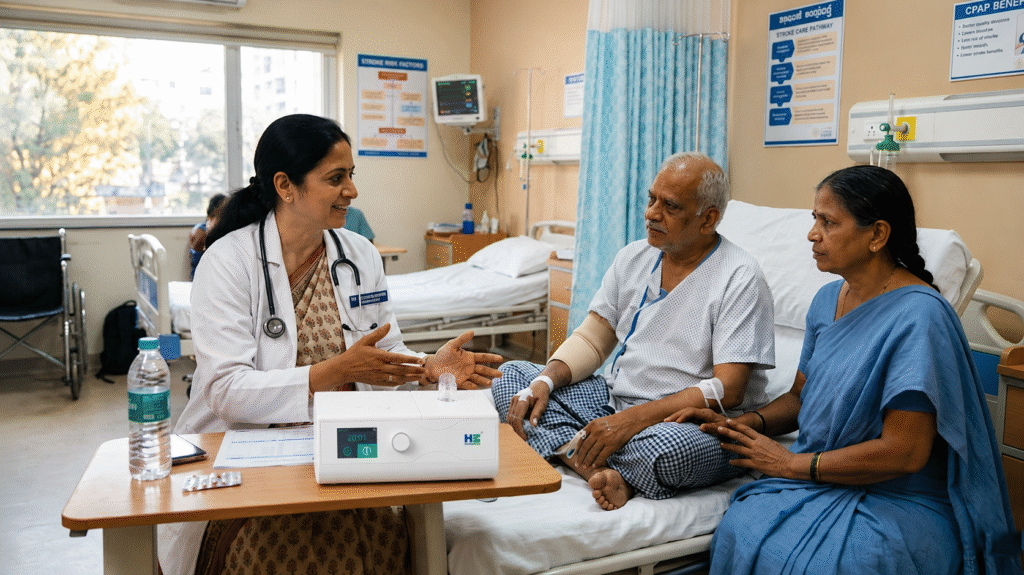
CPAP for stroke recovery patients: evidence and initiation

CPAP for stroke recovery patients: evidence and initiation

Stroke and sleep apnea have a two-way relationship that clinicians have understood for two decades but Indian practice is still catching up to. Untreated obstructive CPAP for stroke recovery patients sleep apnea is an independent risk factor for ischaemic stroke, and stroke itself — particularly when it affects the brainstem, insular cortex, or upper airway motor control — worsens pre-existing OSA or produces new-onset central sleep apnea. For a patient in the post-stroke rehabilitation phase, CPAP for stroke recovery patients evaluating and treating sleep-disordered breathing is part of secondary prevention and cognitive CPAP for stroke recovery patients recovery, not a separate pulmonology consult.

This article covers the clinical evidence for CPAP in stroke recovery, the practical timing and initiation challenges, mask-fit considerations when hemiparesis is present, and what stroke-rehab-focused sleep practice looks like in the Indian context.

The bidirectional relationship

OSA raises stroke risk

Multiple large cohort studies have demonstrated that moderate-to-severe untreated OSA (AHI ≥ 15) roughly doubles the risk of incident ischaemic stroke, independent of hypertension, age, and conventional vascular risk factors.  CPAP for stroke recovery patients The mechanisms are several: recurrent nocturnal hypoxia driving sympathetic surge and vascular inflammation; intrathoracic pressure swings straining atrial wall and promoting atrial fibrillation; endothelial dysfunction; and nocturnal blood pressure surges that non-dipping patients carry through into daytime. homemedix Treatment of OSA with CPAP in primary prevention trials has produced modest reductions in composite cardiovascular endpoints, with stroke as a secondary endpoint; the magnitude of effect depends heavily on adherence.

Stroke worsens OSA

Post-stroke, roughly 50–70% of patients screened by polysomnography have sleep-disordered breathing with AHI ≥ 10 — substantially higher than the age-matched general-population prevalence. The excess is driven by:

Pharyngeal motor control loss

particularly in strokes involving the insular cortex and brainstem, where the neural drive to the upper airway dilator muscles is impaired.uctus nec ullamcorper mattis, pulvinar dapibus leo.

Supine-preferential sleeping

hemiparetic patients often sleep supine because lateral positioning is uncomfortable or unmanageable; supine sleep is a strong positional trigger for OSA.

Obesity and deconditioning

Obesity and physical weakness are often seen in stroke patients. They can narrow the upper airway, reduce breathing efficiency, and make sleep apnea worse during recovery

New central events

Brainstem stroke can disturb the brain’s breathing control system, causing irregular breathing patterns like Cheyne-Stokes respiration, where breathing repeatedly becomes deep, shallow.

For a rehabilitating stroke patient, untreated OSA is associated with slower functional recovery, more depression, more cognitive impairment, and higher recurrent-stroke risk. The evidence for CPAP improving recovery is more modest and less consistent — CPAP trials in acute and sub-acute stroke have generally shown an improvement in daytime CPAP for stroke recovery patients  alertness and some cognitive metrics,  with smaller effects on motor recovery and mixed effects on cardiovascular outcomes. Adherence in these trials was a significant confounder.

When to initiate CPAP post-stroke

The AASM and ATS recommendations, adapted to practical settings:

A reasonable rule for Indian rehab settings: screen for OSA at week 4 post-discharge from acute care, treat at threshold.

Mask-fit considerations in hemiparesis

A stroke patient with hemiparesis faces practical initiation challenges that an able-bodied OSA patient does not:

Unilateral facial weakness

 drooping of the affected side of the face can cause asymmetric mask seal. A mask that seals on the unaffected side may leak on the paretic side, CPAP for stroke recovery patients particularly with nasal-pillow and minimal-cushion interfaces. Full-face masks with flexible cushion contact points handle this better than nasal pillows

Reduced manual dexterity

buckling a four-point mask harness one-handed is difficult. Masks with magnetic clips (ResMed AirFit N20, AirFit F20 with magnetic headgear variants) or quick-release mechanisms are easier. A caregiver-assisted initiation is the norm in the first weeks.

Impaired swallow and aspiration risk

post-stroke dysphagia is common. A patient with impaired swallow on a full-face mask delivering positive pressure is at theoretical risk of gastric insufflation and subsequent regurgitation. A speech therapist and/or sleep physician CPAP for stroke recovery patients  should confirm swallow status before full-face-mask initiation. Nasal masks and nasal pillows avoid the oral airway entirely and are preferred in patients with significant dysphagia.

Cognitive and communication impairment

some stroke patients cannot self-report whether the mask is uncomfortable or whether the pressure feels wrong. Objective monitoring (leak, residual AHI, usage hours) becomes more important, and the caregiver’s observations become essential.

Positional restrictions

 a patient who must sleep supine or on one specific side because of pressure-ulcer prevention or hemiparetic positioning may not have the option of the lateral position that CPAP for stroke recovery patients naturally reduces AHI. The therapeutic pressure prescription should be set for the patient’s actual sleeping position, which in practice is usually supine.

Our practical recommendations for mask selection in post-stroke CPAP initiation:

1

Start with a nasal mask (ResMed AirFit N20, Philips DreamWear, BMC iVolve) if the patient is primarily a nasal breather and dentition supports mouth closure. Nasal masks are the most forgiving of facial asymmetry.

2

Use a full-face mask (ResMed AirFit F20, Philips Amara View) if mouth-breathing is documented or if nasal patency is compromised — but confirm no aspiration risk first.

3

Avoid nasal pillows as first-line in hemiparetic patients; the interface is unforgiving of asymmetric seal and many patients cannot comfortably position the pillow tips.

4

Start with a nasal mask (ResMed AirFit N20, Philips DreamWear, BMC iVolve) if the patient is primarily a nasal breather and dentition supports mouth closure. Nasal masks are the most forgiving of facial asymmetry.

CPAP initiation and adherence data in stroke populations

Published adherence figures in post-stroke CPAP initiation are lower than general OSA populations — commonly 50–60% of patients meeting the 4-hours-per-night threshold at 90 days, HomeMedix CPAP for stroke recovery patients, compared to 70–80% in routine OSA populations.

The reasons are consistent with the clinical picture: cognitive impairment reduces tolerance for mask-wearing, hemiparesis makes self-management harder, depression (common post-stroke) reduces adherence with most health-behaviour interventions, CPAP for stroke recovery patients and the patient’s support network is often already stretched by the rehab demands.

What improves adherence in this population:

Caregiver involvement at initiation

A spouse or adult child who is trained on mask fitting, CPAP for stroke recovery patients cleaning, and troubleshooting at the time of setup is the single biggest predictor of CPAP adherence.

Telehealth coaching

Structured check-in calls at weeks 1, 2, 4, and 12 post-initiation produce measurable adherence improvements — typically in the range of 10–15 percentage points on the compliance metric.CPAP for stroke recovery patients In an Indian context where routine home visits are rare, phone-based coaching is a realistic substitute.

Mask change early rather than late

If the first mask is not working by day 14, change it. The patient has already developed a negative association with CPAP, CPAP for stroke recovery patients and further troubleshooting on a poor-fitting mask reinforces the aversion.

Address nasal congestion aggressively

Post-stroke patients are often on multiple medications with drying effects, and untreated nasal congestion undermines any mask strategy. Nasal saline, humidification, and short courses of nasal decongestant or topical steroid are worth the effort.

Indian stroke-rehab reality

A typical Indian post-stroke care path:

Acute admission at a tertiary hospital, 5–10 days on average.

Discharge home directly, or to a short-stay rehab facility in larger cities.

Outpatient physiotherapy at a nearby clinic, with variable adherence.

No formal sleep-medicine pathway at most centres — unless the patient’s physician proactively refers.

The gap in this path is usually the sleep study. Home-based pulse-oximetry screening is cheap (often under ₹3,000 in most Indian cities), widely available, and will flag the patients who need polysomnography. In-lab PSG costs ₹6,000–12,000 depending on the city and remains the confirmatory test of choice. HomeMedix CPAP initiation at home with a local respiratory therapist visit — a service that is offered at variable quality by distributors in most metros — bridges CPAP for stroke recovery patients the gap between prescription and therapy success.

For families caring for a stroke survivor in an Indian context, the practical advocacy is: ask the treating neurologist about sleep-disordered breathing screening at the first post-discharge follow-up. If the answer is “we don’t usually do that,” push for a home oximetry or HSAT (home sleep apnea test). homemedix CPAP for stroke recovery patients The cost is small, and the downstream benefit — both in quality of sleep for the patient and caregiver and in recurrent-stroke risk reduction — is meaningful.

A closing clinical note

CPAP is not a stroke-recovery treatment per se. It is a treatment for a common comorbidity that, when addressed, removes an impediment to recovery. The best available evidence supports offering   CPAP to post-stroke patients with moderate or severe sleep-disordered breathing as part of the overall secondary-prevention package, while being realistic that adherence will be more fragile than in general OSA populations and that the outcome benefits, while real, are modest.

Consult your treating neurologist before initiating CPAP post-stroke to confirm CPAP for stroke recovery patients neurological stability and appropriate timing.

Q&A

Can CPAP help after a stroke?

Yes, CPAP may support recovery by improving sleep quality and reducing breathing interruptions.

Usually after the patient is medically stable and advised by a doctor.

Stroke can affect breathing control, muscle strength, and sleep posture.

Yes, caregivers help with mask fitting, cleaning, and regular usage.

No, CPAP should be used only after proper sleep apnea screening and medical guidance.

Leave a Reply

Your email address will not be published. Required fields are marked *