
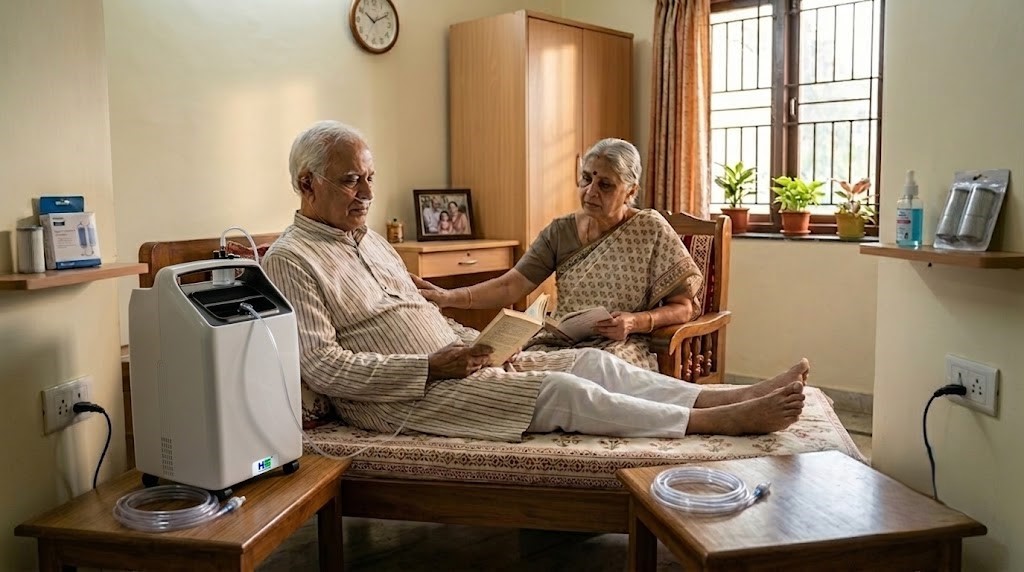
How PSA oxygen concentration actually works: a technical walkthrough
An PSA oxygen concentrator is not a refinery. It does not manufacture oxygen from other elements and it does not store gas from a prior fill. It separates the oxygen already present in room air from the much larger volume of nitrogen, argon, carbon dioxide, and water vapour that surrounds it. The mechanism — pressure swing adsorption, or PSA oxygen concentrator — is a fifty-year-old piece of chemical engineering that found its way into bedside medical devices because the underlying materials and compressors have become cheap enough to run in a living-room footprint.
Understanding the mechanism does real work for clinicians and engaged patients. It clarifies why manufacturer purity claims look the way they do (93% ± 3%, not 99%), why purity falls at altitude, why Indian monsoon humidity is a sieve-bed killer, and why a well-maintained concentrator eventually needs a sieve replacement that costs a meaningful fraction of the whole device. None of that is marketing — it is direct consequence of the adsorption isotherms and cycle timing described below.
The starting material
Atmospheric air at sea level is, by volume, approximately 78.09% nitrogen (N₂), 20.95% oxygen (O₂), 0.93% argon (Ar), 0.04% carbon dioxide (CO₂), and a varying 0.1–4% water vapour depending on temperature and relative humidity. For PSA, the problem reduces to: remove N₂ from the air stream as efficiently as possible. CO₂ and H₂O are removed by upstream scrubbing and drying; argon is the troublesome residual that sets the purity ceiling.
The volumetric ratio that matters: to produce one litre of 93% O₂ per minute, the PSA oxygen concentrator processes roughly five litres of ambient air, discards about four of mostly-N₂, and retains one as O₂-enriched product. That 5:1 air-to-product ratio is why the compressor and beds inside a 5 LPM unit are as large as they are.
The PSA cycle in detail (Skarstrom cycle)
The classical two-bed cycle that every home concentrator implements in some variation was patented by Charles Skarstrom at Esso in 1960. A home concentrator contains two sieve beds, a compressor, a product tank, an inlet filter stack, and a solenoid or rotary valve manifold that sequences the beds through a repeating cycle at a rate of roughly 4–12 full cycles per minute (5–15 seconds per half-cycle).
The four phases of the Skarstrom cycle, in order:
Pressurisation of bed A
Compressed air (typically 1.4–2.1 bar gauge, depending on manufacturer) enters bed A through an inlet valve. Pressure rises in the bed from near-atmospheric to the full feed pressure over 1–3 seconds.
Pressure equalisation and switch
Before the next half-cycle, the beds briefly connect so pressure from the active bed partially charges the freshly purged bed. This reduces compressor load, smooths pressure changes, and prepares the system to switch: bed B adsorbs while bed A purges.
Pressure equalisation and switch.
Before the next half-cycle, the beds briefly connect so pressure from the active bed partially charges the freshly purged bed. This reduces compressor load, smooths pressure changes, and prepares the system to switch: bed B adsorbs while bed A purges.
Adsorption on bed A.
Compressed air enters bed A as the outlet valve opens to the product tank. Nitrogen adsorbs strongly onto the zeolite, while oxygen and argon pass through. This produces an oxygen-enriched stream that flows into the product tank for delivery.
Modern home concentrators use variations on this pattern — Skarstrom-with-equalisation, vacuum swing adsorption (VSA) in some industrial units, rapid-cycle PSA oxygen concentrator in portable devices — but the core physics is identical. One bed loads while the other unloads. The compressor runs continuously. Product flow at the meter is the time-averaged output of whichever bed is currently adsorbing.
Why nitrogen adsorbs preferentially to oxygen on zeolite 13X
This is the load-bearing chemistry. A zeolite is a crystalline aluminosilicate — specifically, a three-dimensional framework of (SiO₄)⁴⁻ and (AlO₄)⁵⁻ tetrahedra that defines a regular array of cages connected by pore windows. The framework charge from the Al substitution is balanced by extra-framework cations (Na⁺, Li⁺, Ca²⁺, K⁺, depending on the zeolite type). Zeolite 13X is specifically the sodium-exchanged form of the X-type faujasite framework, with a roughly 13 Å pore aperture that admits both N₂ and O₂ without molecular exclusion.
Inside the cage, the adsorption physics is governed by three contributions to the binding energy:
1
Dispersive (van der Waals) interactions — similar for both N₂ and O₂, small difference.
2
Field-quadrupole interactions between the extra-framework cation’s electric field and the adsorbate’s electric quadrupole moment. This is where N₂ and O₂ diverge. The N₂ quadrupole moment is approximately 4.7 × 10⁻²⁶ esu·cm², roughly 3.5 times the O₂ moment (1.3 × 10⁻²⁶ esu·cm²). In the strong electric field around a Na⁺ cation, N₂ binds more tightly than O₂ by a factor of 2–3 in equilibrium loading at typical PSA operating pressures.
3
Molecular size effects — N₂ kinetic diameter is 3.64 Å vs O₂ at 3.46 Å. This matters less for 13X (the pore is much larger than either molecule) but becomes relevant for kinetic separations on smaller-pore sieves like 4A or 5A, where molecular sieving dominates over thermodynamic selectivity
The Henry’s-law selectivity α = K_N₂ / K_O₂ on 13X at typical operating conditions is about 3–4. In plain English: at equal partial pressure, about three to four times as much N₂ dissolves into the zeolite as O₂. Over a few-second cycle at 1.5 bar, this is enough to strip roughly 95% of the N₂ from the feed stream before the adsorption wave breaks through to the bed outlet.
The adsorption isotherm is well-fit by the Langmuir model for both species:
q = q_m × (b × P) / (1 + b × P)
where q is the adsorbed amount, q_m is the monolayer capacity, b is the Langmuir equilibrium constant, and P is the partial pressure. The key design variable for PSA oxygen concentrator is the difference in b between N₂ and O₂, because b × P roughly sets the filling of adsorption sites at feed pressure and the emptying of sites at vent pressure. A large b ratio means a clean pressure swing.
Argon is the frustrating exception. Its quadrupole moment is effectively zero (spherically symmetric atom), so its binding is dominated by dispersive forces that are nearly identical to O₂. The α_Ar/O₂ selectivity on 13X is close to 1.0. Any argon in the feed passes through the bed at the same rate as oxygen, and the 0.93% argon in atmospheric air ends up concentrated in the product stream to approximately 4.5% — fixing the thermodynamic ceiling on 13X PSA output at 95–96% O₂ with the balance as Ar.
LiLSX: why lithium-exchanged low-silica X outperforms 13X
Replacing the Na⁺ cations in the X framework with Li⁺ produces lithium low-silica X zeolite, LiLSX (sometimes labelled LiX). Two things change.
First, Li⁺ is smaller and has a higher charge-to-radius ratio than Na⁺. The electric field at the cation site is stronger, and the field-quadrupole interaction with N₂ is correspondingly stronger. The Henry’s-law N₂/O₂ selectivity on LiLSX rises to roughly 6–10, depending on the exchange completeness, at room temperature — roughly double that of 13X.
Second, the “low-silica” qualifier matters. The Si/Al ratio in LSX is at or near the theoretical minimum of 1.0 (Loewenstein’s rule), meaning the maximum possible density of framework-charge-balancing cations. A fully Li-exchanged LSX has roughly 50% more Li⁺ sites per unit volume than a typical NaX, multiplying the adsorption capacity.
The practical consequence is a steeper breakthrough front and a smaller required bed size for the same product flow at the same purity. A 5 LPM concentrator using LiLSX can achieve 93–95% purity with a bed mass roughly 30–50% smaller than an equivalent 13X design, which translates directly to a smaller, lighter, quieter unit running a smaller compressor. Portable POC-class concentrators rely on LiLSX essentially universally, because the bed size reduction is what makes 2.5 kg portable PSA oxygen concentrator possible.
The trade-off is cost. LiLSX costs several times more per kilogram than 13X and is more water-sensitive — one bulk-water exposure can destroy capacity irrecoverably. See sieve-bed lifespan and degradation.
The compressor: why it matters
The PSA cycle is only as clean as the feed it receives. Home PSA oxygen concentrator overwhelmingly use oil-free, dry-running compressors — either rocking-piston or rotary-vane designs — specifically because any oil in the feed air would coat the sieve pellets and destroy their gas-transport capacity. The choice of oil-free compression is therefore not a design preference; it is a hard requirement for a long-life sieve bed.
Typical 5 LPM compressor specs: 1.4–2.0 bar gauge output, 50–80 LPM air flow at feed, 200–400 W motor. 10 LPM roughly doubles these. Published power figures — Philips Everflo 5 LPM at 350 W, Nidek Nuvo Lite 5 LPM at 290 W — mostly reflect compressor motor draw.
The compressor runs at essentially 100% duty cycle. Lifetime-limiting components in rough order: compressor head (20,000–40,000 hours before rebuild), sieve beds (10,000–20,000 hours), solenoid valves (10⁶–10⁷ cycles, 3–7 years), cooling fan (2–5 years).
Why 93% ± 3% is the delivered-purity spec
Putting the pieces together explains why essentially every home PSA oxygen concentrator in the Indian market — regardless of manufacturer or price tier — publishes a purity spec of 93% ± 3% or very close to it.
The argon ceiling limits any 13X-based or LiLSX-based PSA process to about 95.5% oxygen purity at atmospheric feed, because argon passes through the sieve almost like oxygen.
Adsorption is not perfect. A small amount of nitrogen remains in the adsorption bed each cycle, adding about 1–2% contamination to the oxygen output.
Compressor ripple and tank smoothing allow some low-purity gas from the end-of-adsorption phase to enter the product stream, especially during rapid cycle transitions.
Flow-dependent breakthrough. At higher product flows, the adsorption front moves faster through the bed and breaks through sooner, further reducing purity. This is covered in detail in
The net effect is a published spec of 93% ± 3% (i.e. 90% to 96%) across the rated flow range. Delivered purity above 96% at full flow on a pure PSA oxygen concentrator process is physically unusual and should be treated with skepticism absent a third-party certificate. Hospital-grade oxygen at ~99.5% is produced by cryogenic air distillation (the Linde process), a completely different technology that is not practical in a bedside device. We cover this in detail in why 93% is the ceiling.
Cycle tuning: throughput vs purity
Higher feed pressure → more N₂ adsorbed per cycle → cleaner product, but higher compressor power and noise. Most home concentrators sit at 1.4–2.0 bar gauge; industrial PSA units run 4–8 bar.
Shorter cycle time → more switches per minute → the bed never saturates with N₂ → cleaner product, but more valve wear and more pressure-ripple in the product tank.
Higher purge ratio → bed more completely regenerated → better next-cycle capacity → cleaner product, but lower net product yield (more of the O₂ produced is consumed in the purge).
Every home concentrator sits at an empirically tuned compromise among these. A well-designed unit at 5 LPM with a LiLSX bed might run at 1.5 bar, 8-second half-cycles, 30% purge ratio, delivering 93 ± 2% at the full rated flow. The same bed geometry with different cycle timing could deliver 95% at 3 LPM or 88% at 7 LPM — and that exact curve is what the flow-vs-purity graph in a factory test looks like.
Clinical and practical implications
The mechanism has several consequences that matter to prescribing clinicians and patients.
Purity at the prescribed flow matters more than peak-rated purity. A 5 LPM unit that reads 93% at 2 LPM and 86% at 5 LPM is operating normally. A 5 LPM unit that reads 90% at 2 LPM and 78% at 5 LPM is failing — either early sieve degradation, a valve issue, or a compressor losing pressure. The shape of the flow-vs-purity curve tells a service technician more than any single-point reading.
Ambient conditions affect output. Hot, humid, dust-heavy environments stress every component. In the Indian context: Delhi-NCR summer (40–45 °C ambient, PM2.5 regularly over 150 µg/m³) is harder on a concentrator than Bengaluru year-round. Service intervals for inlet filters should be shortened during monsoon and summer in the heavy-use states.
Altitude derating is real. A PSA oxygen concentrator rated to 2,500 m (most mainstream 5 LPM units; the Everflo and Nuvo Lite both specify 7,500 ft ≈ 2,286 m) will run above that altitude but with progressively falling purity. See our article on oxygen therapy at altitude in India for the clinical adjustment framework.
Power loss is recoverable. A PSA oxygen concentrator resumes full output within a few minutes of power restoration; the sieve cycle re-stabilises quickly. There is no permanent damage from ordinary power interruption — though voltage transients and low-voltage operation are separate risks covered in voltage fluctuations and concentrator warranty.
Sieve replacement is a scheduled event, not a failure. A concentrator at 2–4 years of continuous use is approaching the end of sieve life regardless of how well it has been maintained. Budget for sieve service at roughly 20–30% of the original unit cost somewhere in the 3–5 year window.
Common myths and misconceptions
1
“100% oxygen machine” — no such thing in this product class. A PSA concentrator claiming 99%+ is either miscalibrated, marketing hyperbole, or has a second-stage purification (vanishingly rare bedside). The zeolite-PSA ceiling is ~95–96% with argon as the balance.
2
“Oxygen generator” — the device concentrates O₂ from ambient air; it does not generate it. In a sealed room the total oxygen is unchanged.
3
“The OPI is broken because it reads yellow/red.” OPIs fire at ~82% and below. They are detecting what they were designed to detect — most often a flow above the clinically useful range, a clogged inlet filter, or early sieve degradation.
4
“Argon is dangerous.” Argon is biologically inert. The ~4–5% argon in PSA output is clinically a non-issue.
5
“Humidifier bottles improve purity.” They do not; they are for patient comfort. Running one without distilled water can damage the unit via back-pressure or mineral ingress.
What this tells you when shopping
Published purity specs of 93% ± 3% are a feature, not a limitation. A unit claiming materially higher purity at full flow is either using a non-PSA process (rare and expensive), quoting a best-case number, or overstating its capability.
The compressor is the real lifetime-limiting component. Published service-interval data and the manufacturer’s authorised service presence in your state matter more than a small spec-sheet advantage in purity or noise.
Altitude rating is a hard number. If you live above 2,500 m or travel there frequently, confirm the unit’s rated altitude before purchase — the Philips Everflo and Nidek Nuvo Lite are both specified to 7,500 ft and above that you are out of warranty territory.
LiLSX-based units tend to be smaller, lighter, and more expensive than 13X units at equivalent specs. If the form factor is tight (portable, travel, small flat in a hill station), the LiLSX premium is buying real engineering. For a stationary 5 LPM unit that lives in a corner of a room, 13X is often equally good and cheaper.
Power consumption tracks compressor size, not efficiency per se. A 290 W unit is not necessarily better-engineered than a 350 W unit; it may just have a smaller bed and a smaller compressor producing slightly less output headroom. Compare the flow-vs-purity curve if the manufacturer publishes one.
Consult your treating physician for therapy decisions; this article is educational and does not replace a clinical prescription.
Closing
The PSA oxygen concentrator is a remarkably durable piece of commodity chemical engineering. The underlying adsorption science — Na⁺ and Li⁺ cations in zeolite cages producing a quadrupole-moment-driven selectivity for N₂ over O₂ — has not materially changed in 40 years; what has changed is the cost of the zeolite, the availability of reliable oil-free compressors, and the maturity of the solenoid valves. The output spec of 93% ± 3% is not a shortcoming;
it is what argon-limited zeolite PSA fundamentally produces, and it has been clinically adequate for the overwhelming majority of long-term oxygen therapy prescriptions written in the last three decades. A PSA oxygen concentrator that delivers rated purity at rated flow, reliably, for three to five years, with a serviceable sieve bed and a factory-authorised service network in the owner’s city, is doing everything it is asked to do
FAQ'S
What does a PSA oxygen concentrator do?
A PSA oxygen concentrator separates oxygen from room air by removing nitrogen through zeolite sieve beds.
Why does an oxygen concentrator give 93% oxygen instead of 100%?
Because argon passes through the sieve along with oxygen, limiting PSA purity to about 95–96%.
What is the role of zeolite in an oxygen concentrator?
Zeolite captures nitrogen molecules under pressure, allowing oxygen-enriched gas to pass through.
Why does oxygen purity drop at higher flow rates?
At higher flow, air moves faster through the sieve bed, reducing nitrogen removal efficiency.
When should a sieve bed be replaced?
A sieve bed usually needs replacement after years of heavy use when oxygen purity starts falling.