
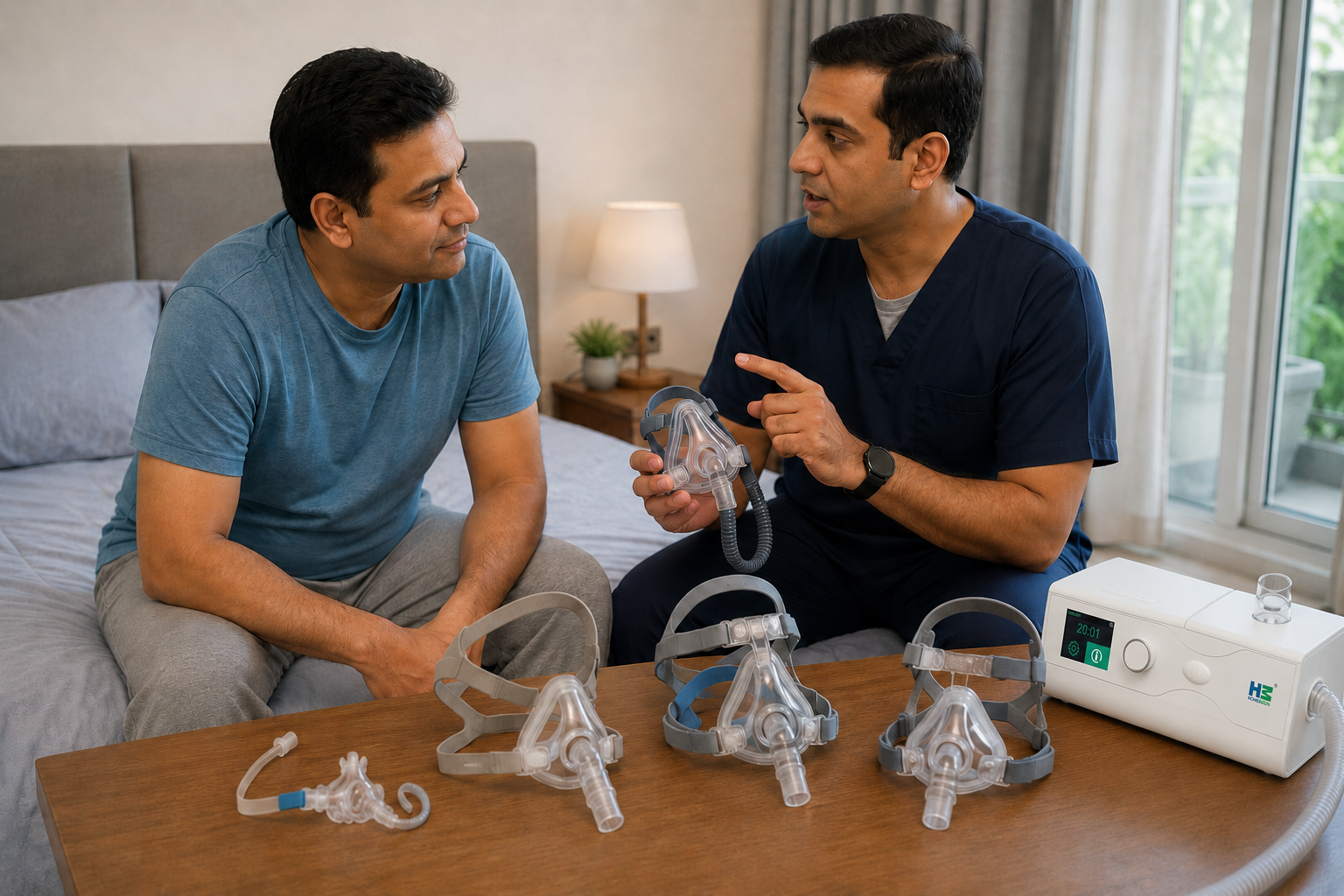
CPAP mask types and Indian facial morphology — nasal pillows, nasal, full-face, hybrid
Mask choice is the variable that most reliably separates a compliant, well-treated CPAP patient from a lapsed one. Pressure is titrated, the machine is bought, the ramp is set — and then the mask is wrong, the patient removes it at 3 AM, adherence collapses, and the whole therapy fails.CPAP mask types in India Getting mask choice right at start is worth more than any other single decision in CPAP initiation, and it is the decision most commonly botched in Indian practice because dealer-level fitting is often a 10-minute transaction against a short menu of available sizes.
This article covers the four major mask categories with representative models in each, fit considerations specific to Indian facial morphology, CPAP mask types in India how to get the fit right when a lab fitting isn’t available, and the commercial realities of dealer return-exchange policies that shape the patient’s actual options.
The four categories
Nasal pillows
Small silicone inserts that seal at the nostril openings. No contact with the nasal bridge or forehead. The lightest-profile interface.
Nasal masks
A triangular cushion that covers the nose from the bridge down to above the upper lip. Seals at the nasal bridge, cheeks, and above the philtrum
Full-face masks
Cover both nose and mouth. Seal at the nasal bridge (or, in under-nose variants, below the nose), cheeks, and under the chin.
Hybrid masks
Covers the mouth like a full-face mask but uses nasal pillows at the nostrils, avoiding the nasal bridge.
Nasal pillows — Swift, AirFit P10, Pico, DreamWear
Representative models. ResMed Swift FX, ResMed AirFit P10, Philips Nuance Pro, Philips DreamWear Gel Pillows, Fisher & Paykel Pilairo Q, Sleepnet Aspire. Among these, the ResMed AirFit P10 is the dominant reference model for minimal-contact nasal-pillows use in India.
Who they suit. Patients who:
- Breathe through the nose throughout sleep (little or no mouth opening).
- Prefer minimal face contact (claustrophobia sensitivity, facial-hair, glasses-in-bed).
- Have adequate pressure tolerance (pillows deliver pressure through small orifices — high pressure with pillows can feel harsher than equivalent pressure through a nasal mask).
- Do not have severe nasal obstruction requiring high pressure deep into the nasal passage.
Common failure modes. Nasal irritation at the nostril rim, dry mucosa (pillows deliver air directly into the nose), pressure intolerance above 13–15 cmH₂O for some patients, displacement if the patient is a side sleeper with aggressive pillow pressure.
Indian facial-fit notes. Nostril diameter and spacing vary. ResMed’s AirFit P10 comes in S/M/L pillow inserts; a proper fit requires trying multiple sizes. Many Indian patients CPAP mask types in India settle between S and M; a small fraction require L. A nostril that leaks with M sometimes seals with S or L (smaller for tighter apposition, larger for more surface area) — don’t assume a single default size fits a given patient.
Nasal masks — AirFit N20, Wisp, DreamWear Nasal
Representative models. ResMed AirFit N20, ResMed Mirage FX, Philips Wisp, Philips DreamWear Nasal, Fisher & Paykel Eson 2, Sleepnet Mojo 2. ResMed AirFit N20 is the most common CPAP mask types in India prescription default in Indian practice.
Who they suit. Patients who:
- Breathe primarily through the nose but want a larger seal area than pillows.
- Have tolerated CPAP with some nasal-bridge pressure (no severe claustrophobia).
- Are on moderate pressures (8–15 cmH₂O typical; nasal masks handle this range comfortably).
- Don’t have significant mouth leak.
Common failure modes. Nasal-bridge marks or sores from excessive headgear tension, leaks over the bridge, CPAP mask types in India mouth leak in patients who open their mouth in sleep.
Indian facial-fit notes. The nasal bridge height and prominence varies across Indian populations. Patients from North/Northwest India with more prominent nasal bridges typically fit the standard nasal-mask shapes (designed around European facial anatomy) reasonably well. Some South Indian, Northeastern, and specific ethnic-group facial morphologies — flatter nasal bridge, wider nasal base — may find that standard Western-designed masks don’t seal cleanly over the bridge. Under-nose nasal-mask variants (DreamWear Nasal, which has the cushion under the nose rather than over the bridge) can be a better fit for these patients.
Sizing: ResMed AirFit N20 ships with S/M/L cushions; start M for most adults, step down to S for smaller faces or narrower bridges. DreamWear Nasal uses a different sizing logic (SW, S, M, MW, L) reflecting width-and-height independently.
Hybrid masks — AirFit F30, DreamWear Full Face (nasal-pillow + mouth)
Representative models. ResMed AirFit F30 (nasal-pillow under-nose + mouth seal), CPAP mask types in IndiaDreamWear Full Face variants with under-nose cushion.
Who they suit. Mouth-breathers who:
- Couldn’t tolerate a standard full-face’s nasal-bridge pressure.
- Want the nasal-pillow simplicity for the nasal interface but need mouth coverage.
- Wear glasses in bed (the under-nose profile leaves the nasal bridge free).
Common failure modes. Mouth leak at high pressures (the chin seal is the limiting factor), CPAP mask types in India nostril irritation from nasal-pillow portion.
Indian facial-fit notes. The AirFit F30 has been adopted reasonably widely in Indian metros for mouth-breathers who want minimal face contact. cushion size range is limited (a couple of options); patients outside that range have few hybrid choices and end up on full-face.
Sizing in practice — lab fitting vs home fitting
The gold standard is a lab fitting: trial multiple sizes and styles with the CPAP mask types in India technologist before committing. In Indian practice, this is the exception. A patient is usually handed a default mask at the dealer’s showroom, at the size the dealer thinks fits, after a brief trial at atmospheric pressure (without actual CPAP pressure), and takes it home.
When lab fitting isn’t available:
Use the manufacturer’s sizing gauges. ResMed, Philips, and Fisher & Paykel all publish printable PDF sizing gauges for their masks. Patients can print the gauge, hold it to their face in a mirror, and measure. Not perfect — a 2D gauge doesn’t capture 3D fit — but better than dealer guesswork. The gauges are available on manufacturer websites.
Ask for the return-exchange programme. All major manufacturers have a 30-day return or size-exchange programme for new masks. The catch: whether an Indian dealer honours it varies by dealer, and patients are often not informed of it at purchase. CPAP mask types in India Before buying, ask explicitly: “If this mask doesn’t fit, can I exchange for a different size or style within 30 days at no charge?” Put the answer in writing (even a WhatsApp message to the dealer is leverage).
Start with the most common defaults. For a typical Indian adult:
- Strong nose-breather, moderate pressure (< 13 cmH₂O): ResMed AirFit P10 (S or M) or DreamWear nasal pillows.
- Nose-breather, any pressure: ResMed CPAP mask types in India AirFit N20 (M default).
- Mouth-breather or mixed breather: ResMed AirFit F20 (M default) or AirFit F30 (M default).
- Glasses-wearer, claustrophobia: DreamWear Nasal or AirFit F30.
If the default doesn’t seal after 3–4 nights of honest trial (with the nightly tweaks described in the dealer instructions), escalate — try different sizes of same model, then try a different category (e.g., switch from N20 to F30 if mouth leak is the issue).
Dealer return-window reality in India
Large dealers (metro chains, manufacturer-authorised)
Generally offer some version of 15–30 day mask return-exchange for unused or lightly-used masks. CPAP mask types in India Policy varies; not always advertised. Put the commitment in writing at purchase.
Mid-sized and regional dealers
Mixed. Some offer exchange; some take the line “mask is a hygiene product, no return.” The latter is commercially convenient but not reflective of CPAP mask types in Indiamanufacturer policy — manufacturers explicitly support authorised dealer exchange programmes.
Online retailers
Increasingly offering 30-day return windows in line with e-commerce norms. CPAP mask types in IndiaVerify the specific seller’s policy before purchase; Amazon / Flipkart-like mask listings from small sellers may not support return
Grey-market dealers, smaller towns
A patient committed to therapy should not buy a mask from a dealer unwilling to support a fit-exchange. A mask is too individual a fit to accept on first-trial; the exchange programme is the mechanism by which patients and dealers find the right fit together.
Mask lifetime and cushion replacement
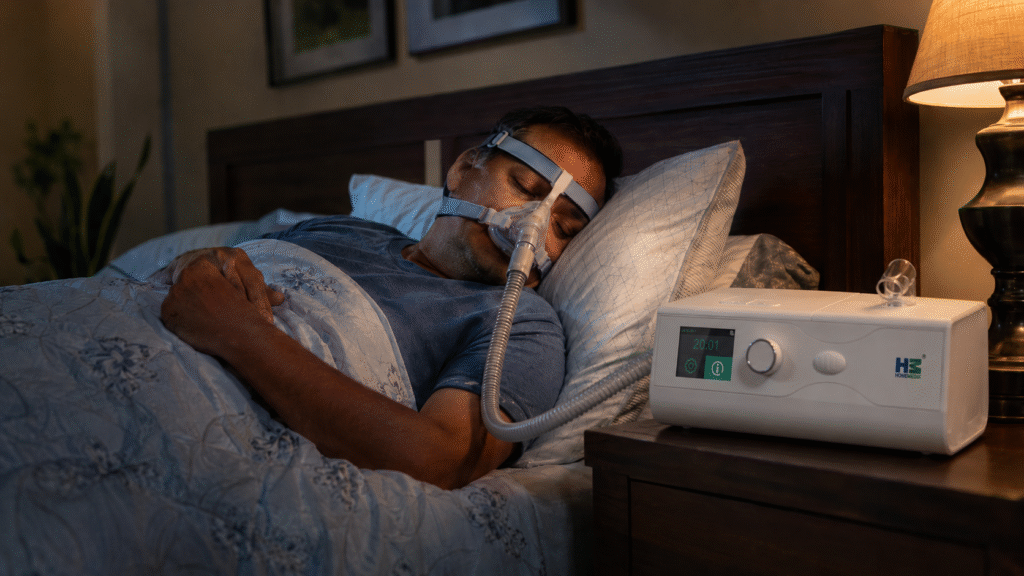
Mask cushions are consumable. CPAP mask types in IndiaPublished manufacturer guidance and Indian dealer experience converge on:
- Cushion replacement every 1–3 months for daily use. The silicone or memory-foam material degrades from skin-oil contact and washing cycles, and a degraded cushion leaks.
- Headgear replacement every 6–12 months.
- Full-mask replacement every 12–18 months typically; some patients push to 24 months with good cushion replacement cadence.
Replacement cushions from manufacturer-authorised channels typically cost 15–30% of a full-mask price. CPAP mask types in India Cumulative annual mask-consumable cost in India runs ₹3,000–₹8,000 depending on mask model and replacement cadence — not trivial, but substantially less than the cost of abandoned therapy.
Pressure-sensitive mask behaviour
Mask category interacts with pressure level. A pressure that is comfortable with one mask type can feel harsh with another:
Nasal pillows at > 14 cmH₂O can feel like a direct air-blast into the nostrils, uncomfortable for many patients. Pressure is concentrated through small orifices.
Nasal masks at > 16 cmH₂O tend to show increased leak over the nasal bridge because the sealing area is limited and high pressure pushes the cushion away from the skin.
Full-face masks handle high pressures best, with the larger sealing surface distributing pressure more evenly. Patients on 15+ cmH₂O often do best on full-face.
Hybrid masks are moderate in pressure tolerance — better than pillows, generally not quite matching full-face at the highest pressures.
When a patient’s titration returns a high pressure (say, 16 cmH₂O), CPAP mask types in Indiathe mask choice should favour full-face or hybrid even if the patient is predominantly a nose-breather. Pressure tolerance trumps breathing-pattern preference at the top of the pressure range.
Specific Indian facial-morphology considerations
Nasal-bridge prominence. Varies. Northern and Northwestern Indian facial morphology often has a more prominent nasal bridge fitting standard Western-designed nasal masks well. Some South Indian, Northeast Indian, and specific ethnic-group morphologies feature a flatter bridge and a wider nasal base; these faces may seal better with under-nose variants (DreamWear Nasal, AirFit F30) than with standard over-bridge nasal masks.
Facial hair. Cultural and religious factors shape beard / mustache prevalence in the Indian male adult population. Mask selection should accommodate rather than attempt to change the patient’s grooming — nasal pillows or specialised beard-friendly cushions preserve both the therapy and the patient’s presentation. Asking a patient to shave daily against cultural or personal preference is unlikely to produce durable adherence.
Cheek width and maxillary projection. The seal at the cheek edge of a full-face mask depends on the cheek-to-nose angle. Narrower, more-projecting cheek structures can leave gaps at the cheek-seal edge on standard full-face masks; wider cushions or alternative styles may fit better.
Chin projection and mandibular shape. Shorter-mandible patients find full-face masks extending too far below the chin. Under-nose full-face variants mitigate this, as does selecting a smaller mask size when cheek-to-nose fit allows.
Clinical takeaway
Mask choice is the highest-leverage decision in CPAP initiation and the most commonly undersupported in Indian dealer-level practice. CPAP mask types in India Categorise by breathing pattern first (nose only, mixed, mouth dominant), then by pressure level, then by anatomical preferences (glasses, claustrophobia, beard). Use sizing gauges when lab fitting is unavailable. Insist on a dealer-level return-exchange commitment before purchase.CPAP mask types in India Plan for cushion replacement on a 1–3 month cadence as an ongoing cost.
HHZ’s editorial view: Indian CPAP initiation would materially improve if dealers were required to offer a documented 30-day mask-exchange programme as a condition of selling the therapy package. Patients should not accept a “no return” policy on a product that must fit their specific face.
Consult your sleep physician or a trained respiratory CPAP mask types in India therapist for fit concerns — a mask that leaks consistently is a therapy failure, not a patient failure, and an appropriate fit solves most cases.
Q&A
1. Which CPAP mask is best for beginners?
The best CPAP mask depends on your breathing style, pressure level, face shape, and comfort during sleep.
2. Who should use a full-face CPAP mask?
A full-face CPAP mask is best for people who breathe through the mouth or have nasal blockage during sleep.
3. Are nasal pillow CPAP masks comfortable?
Nasal pillow masks are lightweight and comfortable for nose-breathers, but they may feel harsh at higher pressure levels.
4. Why does my CPAP mask leak at night?
CPAP mask leaks usually happen because of wrong size, loose fitting, facial hair, mouth opening, or worn-out cushions.
5. How often should CPAP mask cushions be replaced?
CPAP mask cushions should usually be replaced every 1 to 3 months for better seal, hygiene, and therapy comfort.