
Oxygen Concentrator Alarms Explained: Causes, Warning Signs & First Response Guide
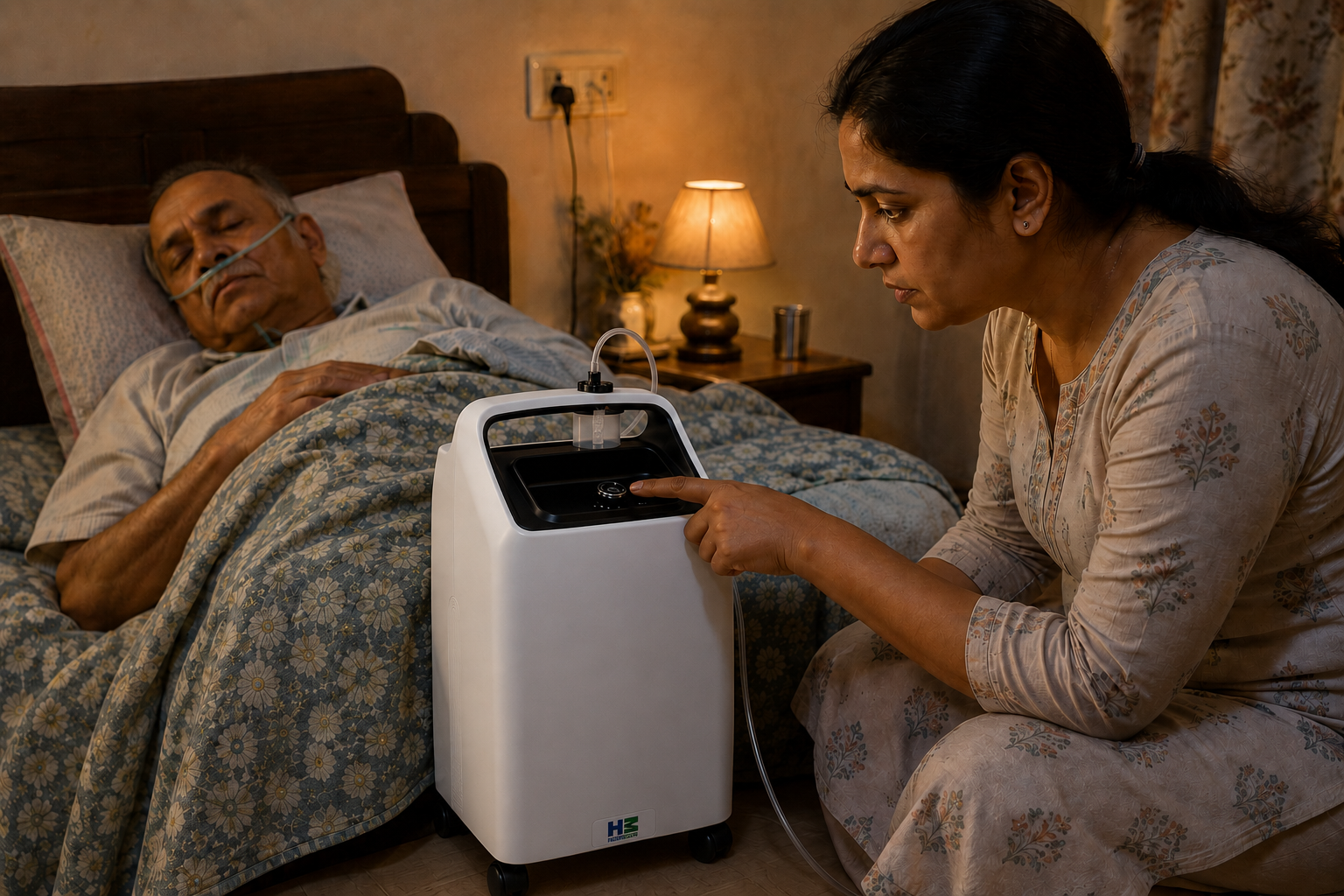
oxygen concentrator alarms.The concentrator beeps at 2 AM. The patient is asleep, or trying to be. The caregiver is standing in front of a machine with four LEDs, a buzzer, and no immediately obvious explanation. This is the most common single caregiver-distress event in home oxygen therapy. It is also the most common moment where the wrong response — pulling the plug, silencing the alarm, waiting until morning — converts a minor fault into equipment damage or a clinical desaturation.
This article walks the full alarm taxonomy used by home stationary concentrators sold in India: low oxygen purity, low pressure, high temperature, no flow / flow failure, power failure, and system malfunction. For each, the discussion covers what the alarm actually signals, the typical root causes, the caregiver’s first-line check, and the decision point at which a service call is the right next step.oxygen concentrator alarms
The alarm taxonomy
Every home stationary concentrator sold in India — Philips, DeVilbiss, Inogen, AirSep, BPL, Oxymed, Nidek, Longfian, Yuwell, Home Medix, and the various rebadged OEMs — uses some subset of six alarm categories. Labels differ, audio patterns differ, LED colours differ, but the physics underlying each alarm is the same across brands because the PSA cycle that all these units run is the same.oxygen concentrator alarms
The six categories:
Low oxygen purity
sometimes labelled OCSI (Oxygen Concentration Status Indicator), OPI (Oxygen Purity Indicator), or “low O₂.” Delivered oxygen concentration has fallen below threshold.
Low pressure
compressor output pressure below the threshold required to drive the PSA cycle.
High temperature
internal temperature sensor above cutoff, typically on the compressor head or exhaust path.
No flow / flow failure
patient-side flow below the set value; sometimes combined with low-pressure, sometimes a separate sensor.
Power fail
mains lost; unit running on an internal backup cell that drives only the alarm, not the compressor
System malfunction
ECU / control-board fault; catch-all for sensor failures, solenoid faults, and self-test failures.
oxygen concentrator alarms.On simple units (most 5 LPM home stationary), these are exposed as coloured LEDs with standard audio patterns: a slow pulsing yellow for purity, a steady red for pressure, a double-tone for temperature, a continuous tone for power. On units with an LCD display (Philips 10 LPM, BPL Oxy-10 Neo, Nidek Nuvo 10, Inogen At Home), the display shows a text code and sometimes a fault number. Writing down the exact code before silencing matters — the code is the first thing any service engineer asks for.
The first thing any new concentrator owner should do, before the patient uses the unit, is read the alarm section of the manual sitting next to the device, identify each LED and audio pattern, and simulate the power-fail alarm (briefly disconnect mains). Knowing what each alarm sounds like in a quiet room in advance is worth more than the user manual in a midnight panic.oxygen concentrator alarms
Low pressure
What it sounds like. Steady, continuous tone on most units; paired with a red “fault” LED. Some units label this “low output” or “compressor pressure.”
What it actually signals. Compressor output pressure has fallen below the threshold required to drive the PSA cycle — typically 15–25 psi depending on the design. The unit cannot complete a normal adsorption phase; some units shut down the flow output entirely, others keep delivering at reduced purity.oxygen concentrator alarms.
Root causes:
- Compressor wear. The rocking-piston or scroll compressor has worn piston rings or valves, and output pressure has declined to the fault threshold. This is an age-and-hours failure, usually after 15,000+ hours of runtime.
- External tubing leak. The most common cause on a unit under two years old. Somewhere between the compressor and the patient, there is a disconnected or cracked tube, an un-seated humidifier bottle, a cracked humidifier lid, or a split cannula connector. The pressure drops because air is escaping before it reaches the flowmeter.
- Solenoid fault. A valve that is supposed to close during a specific PSA phase is partially open, venting pressure. Often detected by the characteristic change in the cycle’s audible pattern.
- Internal tubing leak. Less common. A cracked internal tube, usually in the connection between the compressor and the first sieve bed.
First-line check:
- Walk the entire external circuit — humidifier bottle seal, patient tubing, extension tubing, cannula. Re-seat the humidifier firmly. Replace any obviously damaged segment.
- Listen to the compressor audio cycle. Normal is a rhythmic cycle with clean transitions every 2–8 seconds depending on flow. A wet or rattly cycle points to valve or solenoid.
- If external-circuit repair clears the alarm, the case is closed. If not, call service.
The temptation to ignore a low-pressure alarm because flow at the cannula “still feels fine” is dangerous. A unit running below pressure threshold is delivering reduced purity silently. The purity alarm may not trigger immediately because the sieve bed has surge capacity, but the patient is being under-dosed in the meantime oxygen concentrator alarms.
High temperature
What it sounds like. Double-tone or triple-tone beep pattern; red indicator. Often labelled “Temp” or “High Temp.” On most units, this alarm is followed by protective shutdown within 30–120 seconds if not resolved.
What it actually signals. An internal temperature sensor has exceeded its cutoff. The sensor is typically on the compressor head (which runs hottest) or in the exhaust airflow path.
Root causes:
- Ventilation blocked. The cabinet has been pushed against a wall, curtains have drifted over the intake, or something has fallen onto the top panel blocking the exhaust. This is the modal cause and the easiest fix.
- Ambient temperature above spec. Most concentrators are rated for 5–40°C operation; a few lower-end models cap at 35°C. Peak Indian summers in Rajasthan, Gujarat, Madhya Pradesh, inland Maharashtra, and Andhra Pradesh routinely exceed these limits in bedrooms without active cooling. Move the unit to the coolest room, add a ceiling fan or AC, or shift heaviest use to cooler hours.
- Compressor wear. A worn compressor runs hotter because internal friction is higher. Often accompanies the end of compressor life.
- Cooling-fan failure. Most units have an internal cooling fan; a fan that has stopped spinning means the cabinet cannot dissipate heat. User-detectable by the absence of the fan’s airflow at the exhaust.
First-line check:
- Immediately check clearance — 30 cm on all sides. Move obstacles, pull the unit away from the wall.
- Check the room temperature. If above 35°C, move the unit to a cooler room or start an AC.
- Feel for airflow at the exhaust grille. No airflow means the fan is stopped — call service.
- If the unit shuts down before you can act, let it cool for 20 minutes with the cabinet open to airflow, then restart. Repeated shutdowns in one day indicate a persistent problem and warrant a service call.oxygen concentrator alarms.
No flow / flow failure
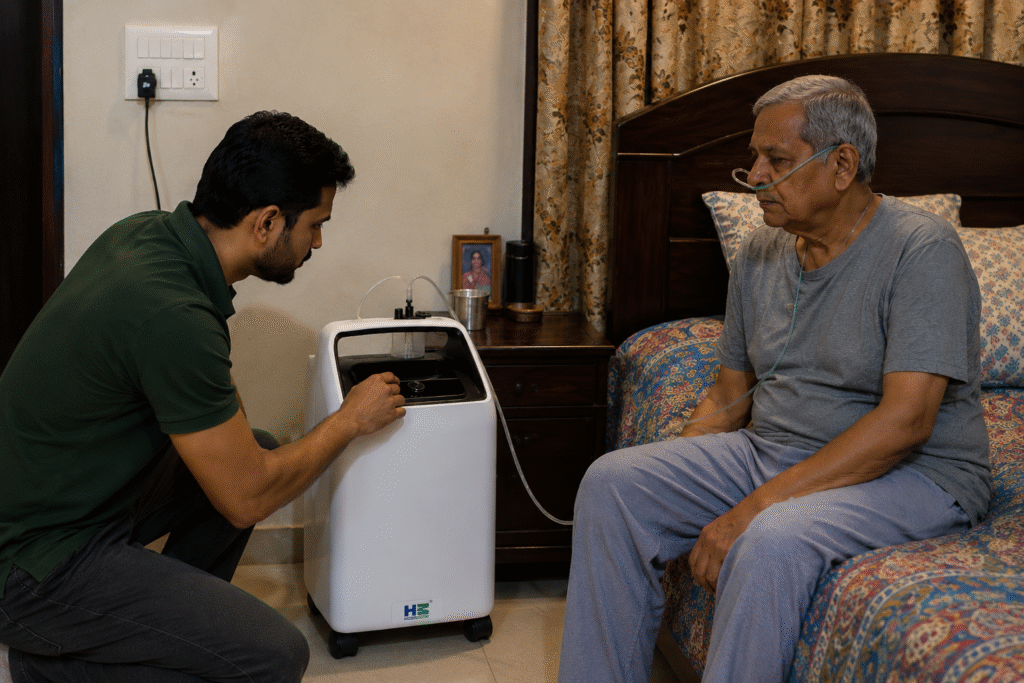
What it sounds like. Continuous tone or rapid beeping; sometimes labelled “Flow fail” or “No flow.” On units with both pressure and flow sensors, this alarm is distinct from low pressure — the compressor may be producing rated pressure, but the flow delivered to the patient is below setpoint.oxygen concentrator alarms.
Root causes:
Kinked tubing
The single most common cause. The patient rolls over in bed, the extension tubing folds under a piece of furniture, the cannula line gets trapped under the caster of a wheelchair. Visual inspection finds this in under a minute.
Kinked tubing
The single most common cause. The patient rolls over in bed, the extension tubing folds under a piece of furniture, the cannula line gets trapped under the caster of a wheelchair. Visual inspection finds this in under a minute.
Kinked tubing
The single most common cause. The patient rolls over in bed, the extension tubing folds under a piece of furniture, the cannula line gets trapped under the caster of a wheelchair. Visual inspection finds this in under a minute.
Kinked tubing
The single most common cause. The patient rolls over in bed, the extension tubing folds under a piece of furniture, the cannula line gets trapped under the caster of a wheelchair. Visual inspection finds this in under a minute.
First-line check:
- Walk the line from concentrator outlet to cannula. Fix any visible kink.
- Disconnect the humidifier and connect the patient tubing directly to the concentrator outlet. If flow recovers, the humidifier is the problem — replace the bottle or clean the diffuser.
- Tap the flowmeter gently with a fingernail. If the flow ball rises normally after tapping, debris was the cause.
- If none of the above, call service.
Power fail
What it sounds like. Continuous high-pitched tone. Always accompanied by the unit going dark — no compressor sound, no other LEDs.
What it actually signals. Mains power is gone. The unit has an internal battery or capacitor-backed alarm that drives only the audible warning — not the compressor. Duration of alarm continuation varies by unit: 5 minutes on most units, up to 20 minutes on a few higher-end models.
Root causes:
- Mains outage / load shedding. The Indian reality for most patients.
- Circuit breaker tripped. A shared circuit drawing too much current has popped the breaker.
- Plug or cord fault. Less common.
- Stabiliser / UPS shutdown. If the unit is on a servo stabiliser that has its own shutdown conditions (e.g., input voltage outside working range), the stabiliser may be dropping power to the concentrator even while mains is present.
First-line check:
- Silence the alarm per the manual (usually holding a specific button for 3–5 seconds).
- If the patient is on continuous oxygen, switch immediately to the backup — a portable O₂ cylinder if one is on hand, a portable concentrator if available, or move the patient to a facility if the outage will be extended.
- Check the stabiliser/UPS/inverter first: is its input LED on? Is its output LED on? A failed stabiliser is more common than people expect.
- Check the building’s main mains: other electrical loads working?
- If the cord is suspect, do not attempt repair — call the dealer.
Any patient on long-term oxygen therapy should have a defined backup plan written down: cylinder size, location, connector type, hours of runtime, contact number for refill. The power-fail alarm is not the time to discover the backup plan.oxygen concentrator alarms.
System malfunction
What it sounds like. Highly variable. Typically a distinct tone pattern from the other alarms, often accompanied by a specific fault code on LCD-equipped units. On non-LCD units, may present as a combination of LEDs that doesn’t match any single alarm description.
What it actually signals. The control board has detected an internal fault that doesn’t fit into any of the other categories. Possibilities include sensor failures, solenoid faults, self-test failures during startup, memory errors, or firmware hangs.
Root causes, per published service bulletins across brands:
- Sensor failure. Temperature, pressure, flow, or purity sensor has failed electrically — the reading is implausible (out of range) and the control board flags it.
- Solenoid fault. A solenoid valve is not responding to the control board’s command, either mechanically stuck or electrically open-circuit.
- Compressor thermal cutoff activated internally. Separate from the high-temp alarm, some units have an independent compressor-internal cutoff that reports back to the control board as a system fault.
- Self-test failure. On startup, the control board runs a sequence of internal checks. Any failure aborts startup and logs a system fault.
- Power supply irregularity. Frequent on units running off poor-quality inverters or under significant voltage sag — the control board’s internal rail is itself unstable and throws errors.
First-line check:
- Record the exact fault code or LED pattern. Power off, wait 5 minutes, power back on. A transient fault will clear.
- If the fault repeats on restart, and the unit has been on an inverter or non-ideal power source, switch to a servo stabiliser with clean mains and retest.
- If the fault still repeats, call the dealer and quote the exact fault code. Do not open the cabinet — opening voids most Indian warranties immediately.oxygen concentrator alarms.
Q&A
Why is my oxygen concentrator beeping?
Your oxygen concentrator may beep because of low oxygen purity, low pressure, high temperature, no flow, power failure, or system malfunction.
What should I do first when the oxygen concentrator alarm starts?
First, check the power supply, oxygen tube, filter, airflow clearance, and alarm indicator before calling service
Can I ignore an oxygen concentrator alarm if oxygen is still flowing?
No, ignoring the alarm is risky because the machine may be delivering low-purity oxygen even when airflow feels normal.
Why does an oxygen concentrator show a low oxygen purity alarm?
A low oxygen purity alarm can happen due to a blocked filter, poor ventilation, sieve damage, or internal leakage.
When should I call service for an oxygen concentrator alarm?
Call service if the alarm continues after checking the filter, tubing, power supply, room ventilation, and proper device placement.