
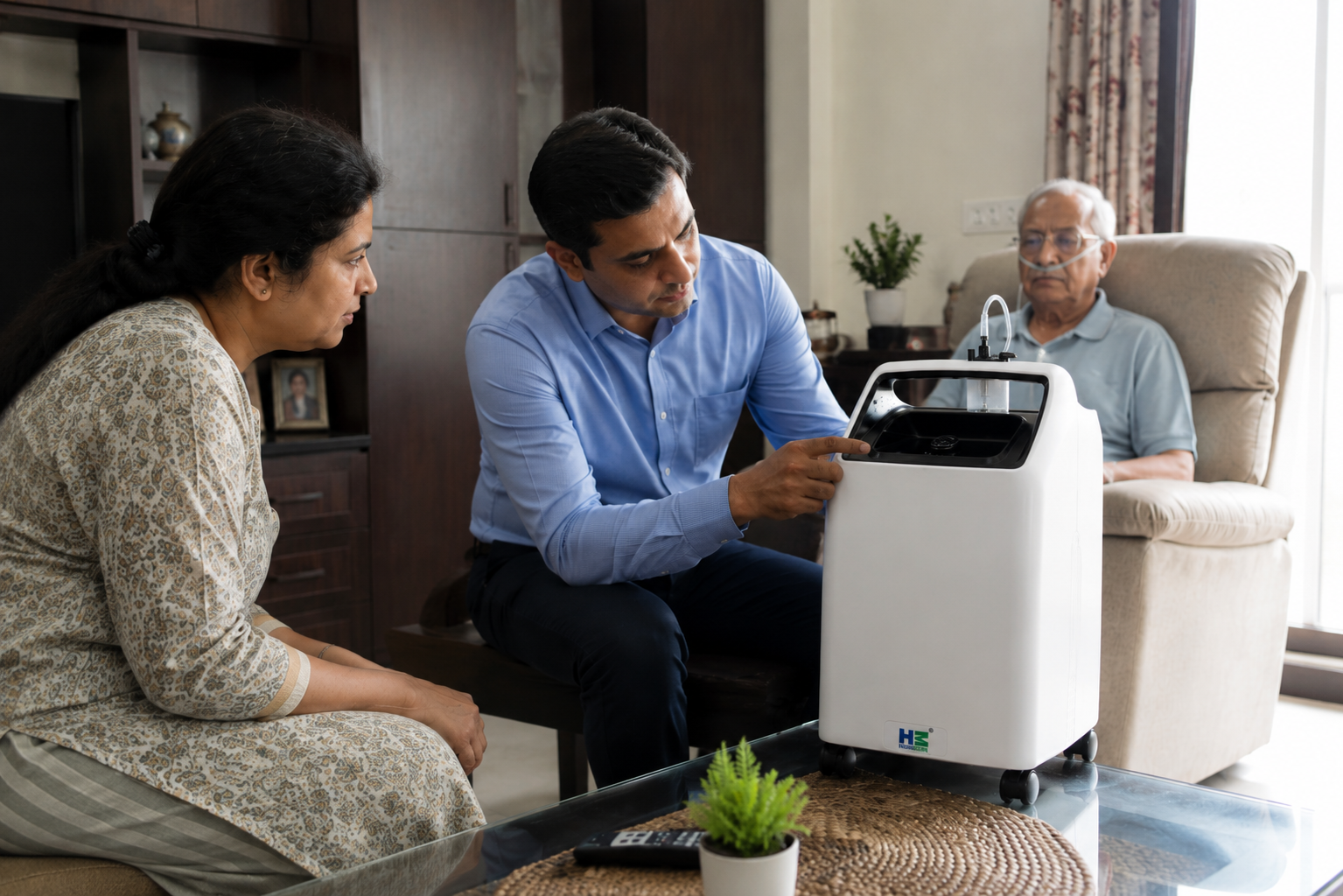
CDSCO Approved Oxygen Concentrator in India: What Home Buyers Must Check
CDSCO approved oxygen concentrator.The Indian medical device landscape changed in 2017 and has been transitioning since. The Central Drugs Standard Control Organization (CDSCO), under the Directorate General of Health Services and the Ministry of Health and Family Welfare, is the national regulatory authority. The Medical Device Rules, 2017 (MDR 2017), under the Drugs and Cosmetics Act, 1940, created a risk-stratified framework for device registration, licensing of import and manufacture, and post-market surveillance. A series of notifications since 2020 has progressively expanded the scope of notified devices — oxygen concentrators, CPAP, BiPAP, and most respiratory equipment are now inside the regulatory net.
For a family buying a home oxygen concentrator, the regulatory framework matters because it determines whether the unit on the table is legally sold in India, whether the importer has a valid licence, whether the warranty is backed by a regulatory registration, and whether the quality claim on the label is verifiable. This article maps the rules that apply, the risk classes, the licence structure, the 2017–2026 transition timeline, how to check a product’s CDSCO approval, why a “CE-certified” badge alone is not sufficient for India, and the grey-market import pattern that leaves patients holding an unenforceable warranty.CDSCO approved oxygen concentrator
CDSCO: what it does
CDSCO is the central authority for drug and medical device regulation. Its functions include:
- Approval of new medical devices for sale in India
- Grant of import licences and manufacture licences
- Grant of loan licences, wholesale and retail licences for certain device categories
- Post-market surveillance: adverse event reporting, device recalls
- Coordination with State Drug Controllers, who are the enforcement authorities on the ground
- Coordination with BIS (Bureau of Indian Standards) where Indian Standards apply
The Drug Controller General (India), or DCGI, heads CDSCO. Notified medical devices are regulated under the MDR 2017, which is the current legal framework replacing the earlier device-specific notifications. (CDSCO)CDSCO approved oxygen concentrator.
MDR 2017: the rule set
The Medical Device Rules, 2017 (MDR 2017), came into force on 1 January 2018. The rules established:CDSCO approved oxygen concentrator
- A risk-based classification system for medical devices, harmonised (broadly) with the Global Harmonization Task Force (GHTF) classification
- Licensing requirements for manufacture, import, wholesale, and retail of notified medical devices
- Quality management system requirements — ISO 13485 or equivalent for manufacturers
- Labelling requirements — manufacturer name, address, importer details, batch/serial number, date of manufacture, expiry (where applicable)
- Post-market surveillance — materiovigilance reporting, recall procedures
MDR 2017 was a major shift from the earlier device-by-device notification pattern. Over 2017–2023, CDSCO progressively notified additional device categories, bringing them under MDR 2017 rather than keeping them in the pre-2017 unregulated space. As of 2024–2026, most therapeutic respiratory devices — concentrators, CPAP, BiPAP, ventilators, nebulisers — are notified and therefore regulated. (CDSCO)CDSCO approved oxygen concentrator.
Class A / B / C / D — the risk stratification
Class A - Low risk
Includes thermometers, surgical dressings, oxygen tubing, nebuliser masks. Licensing is less stringent; manufacturers self-register and get clearance from the state licensing authority.
Class B — Low-moderate risk
Includes hypodermic needles, suction equipment, some basic therapeutic devices. State licensing authority administers approval.
Class C — Moderate-high risk.
Includes oxygen concentrators, CPAP, BiPAP, anaesthesia machines, dialysis equipment. Central licensing authority (CDSCO) administers approval.
Class D — High risk.
Includes implantable devices, pacemakers, heart valves, intraocular lenses. Central licensing authority, with additional clinical investigation requirements.
For home oxygen equipment, the classes that matter are C. A 5 LPM or 10 LPM oxygen concentrator is Class C. A portable oxygen concentrator (POC) is Class C. A CPAP or BiPAP is Class C. A nebuliser compressor is Class B. Oxygen masks and nasal cannulas — Class A.CDSCO approved oxygen concentrator.
This matters because the licensing pathway, documentation depth, and post-market scrutiny all scale with class. An importer bringing in a Class C concentrator needs a central CDSCO import licence (Form MD-14 leading to Form MD-15 for import registration and licence), not merely a state wholesale licence. A dealer selling Class C devices at retail needs a valid retail licence. Any unit in the market that cannot be traced to a holder of the appropriate CDSCO licence is outside the legal supply chain. (CDSCO)CDSCO approved oxygen concentrator.
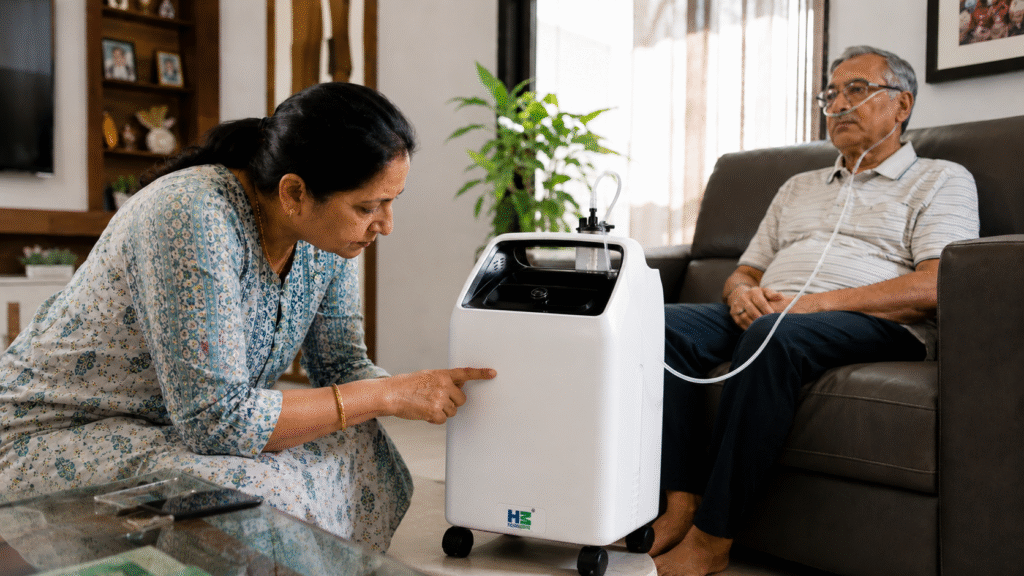
Licence requirements: import versus manufacture
Import registration
the importer applies on Form MD-14, providing the manufacturer’s details, device master file, predicate device analysis, and QMS certification (usually ISO 13485)
Import licence
on Form MD-15, issued after registration. This licence authorises the importer to sell the specific device in India.
Wholesale licence
at the state level, for the importer to hold stock and distribute to retailers.
Retail licence
for each dealer selling to end users.
Each step has its own document trail, inspection, and fee. The import licence is manufacturer- and model-specific — an importer licensed for Model A from Manufacturer X cannot substitute Model B from the same manufacturer without a fresh registration.
Manufacture. A domestic manufacturer of a Class C device:
- Applies on Form MD-3 for test licence (optional, pre-market testing stage).
- Applies on Form MD-5 or MD-7 for manufacturing licence (depending on site and product).
- Maintains QMS (ISO 13485 typical), site compliance with cGMP-equivalent standards.
- Enters the market after licence grant.
A authorises a specific manufacturer to make specific devices at a specific site. Site changes, model changes, and specification changes trigger licence amendment.manufacturing licence CDSCO approved oxygen concentrator.
How to check a product’s CDSCO approval
Four verification steps that a patient or dealer can actually run:CDSCO approved oxygen concentrator
- Check the product label for the importer or manufacturer licence number. A correctly labelled Class C device will carry either the manufacturing licence number (for domestic manufacture) or the import licence number (for imports), along with the manufacturer’s name and address.
- Look up the licence on the CDSCO portal. The CDSCO website (
cdsco.gov.in) publishes lists of approved medical devices, import licences, and manufacturing licences. The search is imperfect — not every grant is indexed in real time — but it covers most licensed products. The SUGAM online portal is the submission and status portal for applications. - Request the licence copy from the dealer. A legitimate dealer should be able to produce, on request, a copy of the import or manufacturing licence for the product they are selling. Dealers who cannot or will not produce this are outside the legal supply chain.
- Cross-check with the manufacturer’s Indian importer. Major brands list their Indian importers on the brand’s global website or in the packaging. If the dealer is selling a brand whose authorised Indian importer is a different entity, the unit may be grey-market.
State Drug Controllers are the enforcement arm. Formal complaints about unlicensed sale go to the State Drug Control department of the state where the dealer operates.CDSCO approved oxygen concentrator
The transition timelines
1 January 2018
MDR 2017 comes into force.
1 April 2020 — 1 October 2022
Voluntary registration window for manufacturers of newly-notified devices. Existing products continue to sell under the “deemed registered” transitional status provided the manufacturer files within the voluntary window.
1 October 2022 — 1 October 2023
Mandatory registration phase for Class A and Class B devices under expanded notification.
1 October 2023 — 1 October 2024
Mandatory registration phase for Class C and Class D devices under expanded notification.
2024–2026
Enforcement phase. CDSCO has increased market surveillance and state drug controllers have begun inspections of dealer premises.
CE, FDA, CDSCO, ISO 13485: four different things
A common retail pattern: a concentrator carton is labelled “CE certified” or “FDA approved” and the dealer tells the patient this means the device is “international standard.” These certifications are not interchangeable, and none of them is a substitute for CDSCO approval for sale in India.
CE mark. A CE mark indicates the device complies with the applicable European Union directive or regulation (for medical devices, now the EU Medical Device Regulation 2017/745, replacing the earlier Medical Device Directive 93/42/EEC). A genuine CE mark for a Class C medical device includes the 4-digit identification number of the Notified Body that assessed the device. CE is European; it is not an Indian, American, or global regulatory approval. A CE-marked device is not automatically legal for sale in India — it still needs CDSCO registration.
FDA 510(k) clearance or PMA approval. These are US Food and Drug Administration authorisations to sell a device in the United States. FDA authorisation is not an Indian approval.
CDSCO registration / licence. This is the Indian authorisation. Without a valid CDSCO import or manufacturing licence, the device is not legally sold in India regardless of what foreign approvals it has.
ISO 13485. This is a quality management system certification for medical device manufacturers. It indicates the manufacturer’s QMS processes meet the ISO standard. It is not a product approval; it applies to the organisation, not to any specific device. A manufacturer can be ISO 13485-certified and still not have CDSCO approval for a specific product.
A correctly licensed Indian concentrator will typically carry some combination of: a CDSCO import or manufacturing licence number, an ISO 13485 reference for the manufacturer, and possibly a CE mark (if the manufacturer supplies the EU market) or FDA clearance (if supplied to the US). The CDSCO licence number is the one that matters for Indian legality.CDSCO approved oxygen concentrator.
Labelling requirements that matter to the patient
A correctly labelled Class C device in India should carry:
- Manufacturer’s name and full address
- Importer’s name and full address (for imports)
- Import or manufacturing licence number under MDR 2017
- Model number and serial number
- Batch number (where applicable)
- Date of manufacture or date of first marketing
- Relevant specifications — for concentrators, typically flow rate, oxygen concentration, power consumption, operating voltage range, operating altitude range
- Safety markings (CE where applicable, plus any India-specific markings)
- Instructions for use and warnings in English (local language may be added but English is mandated)
Labels that are inconsistent across the carton, the unit, and the manual — different model numbers, different importer addresses, different serial-number formats — are a red flag. Counterfeits and grey-market units often fail this consistency test.
Lorem ipsum dolor sit amet, consectetur adipiscing elit. Ut elit tellus, luctus nec ullamcorper mattis, pulvinar dapibus leo.CDSCO approved oxygen concentrator.
Grey-market imports: the warranty graveyard
A unit brought in outside the CDSCO import licence pathway is a grey-market import. Grey-market is not synonymous with counterfeit — the unit itself may be genuine, from the genuine manufacturer. But the importation route is outside the licensed supply chain. Consequences for the patient:
- No Indian warranty. The manufacturer’s global warranty runs through the authorised Indian importer. A unit brought in grey has no registered Indian importer, so the warranty has no one to enforce it against in India. The patient’s only recourse is against the dealer who sold them the unit — and grey-market dealers tend to be small, undercapitalised, and prone to disappearing.
- No service centre access. Authorised service centres verify the serial number against the importer’s register. A grey-market serial number does not appear on the register. The service centre can legally refuse service.
- No parts supply. Compressors, sieves, and electronics are supplied by the manufacturer to the authorised importer. Grey-market units cannot draw on this parts supply chain.
- Consumer recourse is limited. The patient can sue the dealer in a consumer forum, but a dealer with no assets is hard to collect from.
Grey-market units have two typical signatures: noticeably lower price than the authorised importer’s range, and inability of the dealer to produce an import licence or a serial number verifiable with the manufacturer. Both signals should be taken seriously.
During and after the 2021 COVID-19 crisis, when supply chains were stressed, grey-market concentrator imports spiked sharply. Many of those units are still in the field today, with patients who are discovering only now — when the compressor fails — that the importer they bought from is unreachable. (CDSCO)
Post-market surveillance and materiovigilance
India’s medical device materiovigilance programme (MvPI) runs through the Indian Pharmacopoeia Commission (IPC), coordinating adverse event reporting. Patients, healthcare providers, and dealers can report adverse events — unit failures, burn injuries from compressor overheating, oxygen purity below spec — through the MvPI channels. Volume is low compared to the scale of device usage, and reporting discipline varies, but the channel exists and is growing.
Recalls are executed by CDSCO in coordination with the importer or manufacturer. A recall notice appears on the CDSCO website and requires the licence-holder to contact affected patients and retrieve or repair units. Patients who bought through authorised channels are reachable; grey-market patients are not.
Labelling requirements that matter to the patient
A correctly labelled Class C device in India should carry:
- Manufacturer’s name and full address
- Importer’s name and full address (for imports)
- Import or manufacturing licence number under MDR 2017
- Model number and serial number
- Batch number (where applicable)
- Date of manufacture or date of first marketing
- Relevant specifications — for concentrators, typically flow rate, oxygen concentration, power consumption, operating voltage range, operating altitude range
- Safety markings (CE where applicable, plus any India-specific markings)
- Instructions for use and warnings in English (local language may be added but English is mandated)
Labels that are inconsistent across the carton, the unit, and the manual — different model numbers, different importer addresses, different serial-number formats — are a red flag. Counterfeits and grey-market units often fail this consistency test
Q&A
What is a CDSCO approved oxygen concentrator?
A CDSCO approved oxygen concentrator is a medical device legally registered or licensed for sale in India under medical device regulations.
Why should I check CDSCO approval before buying an oxygen concentrator?
Checking CDSCO approval helps ensure the device is legally sold in India and has proper importer, warranty, and service support.
Is CE certification enough for buying an oxygen concentrator in India?
No, CE certification alone is not enough because oxygen concentrators sold in India need valid CDSCO approval or licence.
What is the risk of buying a grey-market oxygen concentrator?
A grey-market oxygen concentrator may not have valid Indian warranty, service support, spare parts, or legal supply-chain backing.
What should buyers check on an oxygen concentrator label?
- Buyers should check the manufacturer name, importer details, model number, serial number, and CDSCO import or manufacturing licence number.