
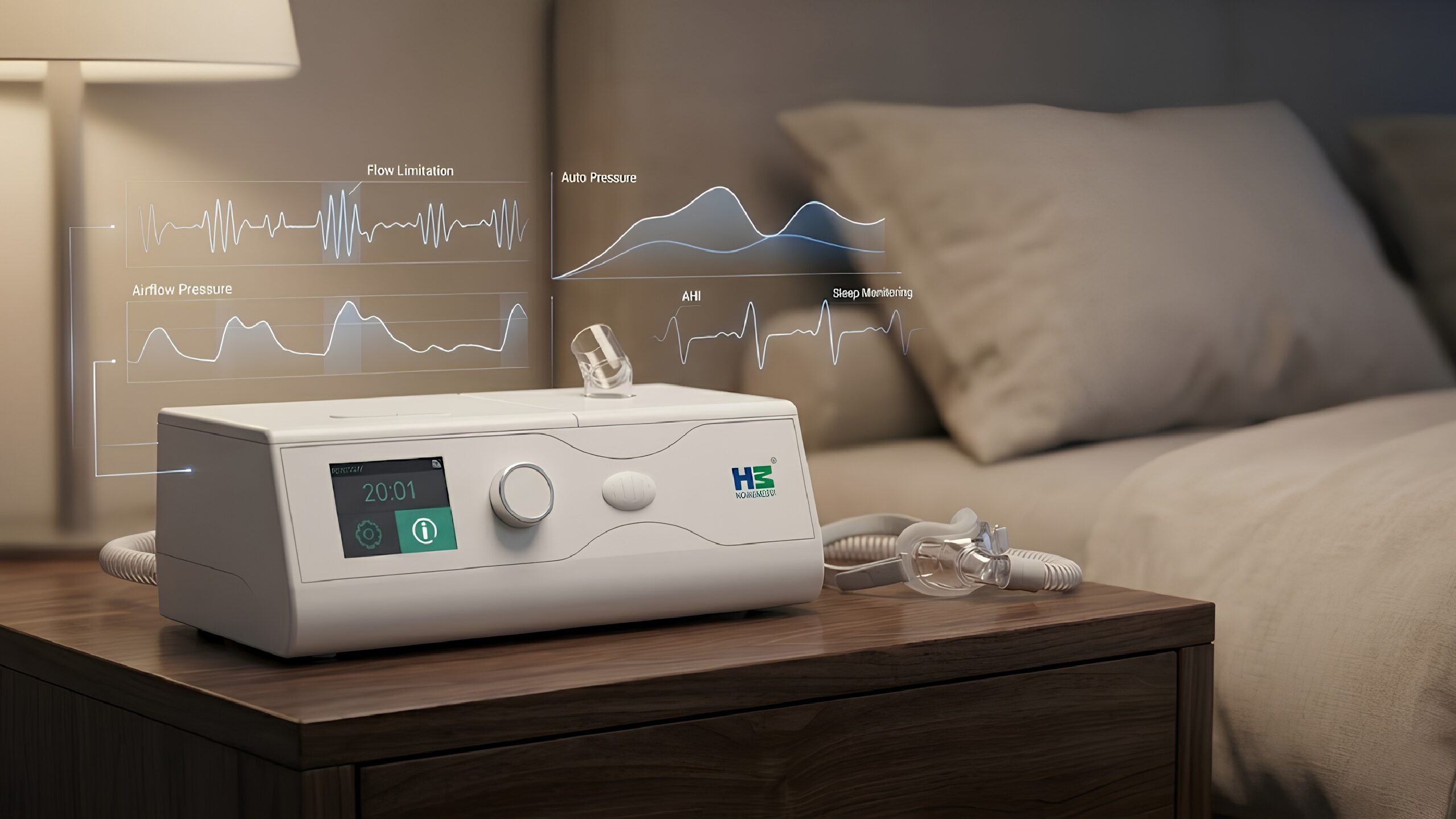
APAP algorithms compared — ResMed AutoSet, Philips Auto, BMC Auto, DreamStation, AirSense
An auto-titrating CPAP delivers pressure that varies breath-by-breath within a prescribed range, guided by the device’s detection of flow limitation, snoring, and apnea events. The same patient on the same night, running two different APAPs within the same pressure range, will experience different average pressure, different 95th-percentile pressure, different residual AHI, and different flow-limitation control. The algorithms are not interchangeable, and the differences matter clinically – a patient whose therapy seems “adequate” on one brand and “marginal” on another is often seeing the algorithm difference, not a change in disease.
This article compares the major algorithms: ResMed AutoSet (on AirSense 10 / AirSense 11 / AirCurve), Philips Auto (DreamStation, DreamStation 2), BMC Auto (RESmart G3 / G4 and OEM variants), and the specific behaviours of each in flow-limitation response, ramp, AutoRamp, soft-start, and for-Her / gender-tuned variants. It closes with empirical evidence on residual-AHI differences and a note on Indian sleep-physician preferences.
Devices Covered
AirSense 10 / 11 · DreamStation 1 & 2 · RESmart G3 / G4
Algorithms
AutoSet · AutoSet For Her · Philips Auto · BMC Auto
Context
Indian clinical practice · Metro & tier-2 cities
ResMed AutoSet — AirSense 10, AirSense 11, AirCurve family
AutoSet is ResMed’s algorithm family, running on essentially the entire current consumer range. The algorithm’s design priorities:
- Flow-limitation sensitivity is high. Inspiratory-waveform flattening is detected quickly, and pressure responds in small increments (0.5–1 cmH₂O per minute of sustained flattening).
- Apnea discrimination via Forced Oscillation Technique (FOT): during a suspected apnea, the device emits a small pressure oscillation and measures the echo. Open airway (central apnea) echoes back; closed airway (obstructive) attenuates. The central vs obstructive distinction on ResMed is more confident than on competitors.
- Pressure-response curves favour not raising pressure for central apneas. When an apnea is classified central (ClearAirway), the algorithm does not increase pressure — because raising pressure doesn’t help centrals and can worsen CompSAS.
- Leak compensation is sophisticated. The algorithm recognises leak-driven flow fluctuations and discounts them, reducing the pressure-runaway failure mode that other algorithms sometimes exhibit.
- AutoSet has two sub-variants:
- AutoSet standard. Default algorithm for most adults.
- AutoSet For Her. Gender-tuned: lower starting pressure, more gradual response curves, more weight to flow-limitation and snore events relative to frank apneas. Rationale is that female OSA phenotypes tend toward more UARS / flow-limitation-dominant presentations at lower mean pressures, and a less-aggressive algorithm is better tolerated. Evidence base is modest but consistent with the clinical observation.
- In Indian clinical practice, AutoSet is the most commonly prescribed APAP algorithm at metro sleep-medicine centres, largely because of the perceived tight flow-limitation handling.
Philips Auto — DreamStation, DreamStation 2
Philips’ Auto algorithm on DreamStation family uses a different architecture:
Apnea discrimination
Apnea discrimination via a proprietary “cardiac pulse through the airway” signal — the arterial pulse transmitted through the airway is detected in the flow channel during an apnea, indicating airway patency.
Flow-limitation detection
Flow-limitation detection is present but published evidence suggests lower sensitivity than ResMed, leading to higher residual flow-limitation index on equivalent patients.
Pressure-response curves
Pressure-response curves are somewhat slower to react to sustained flow limitation and somewhat faster to react to apneas/hypopneas.
C-Flex
C-Flex pressure-relief is the default expiratory comfort feature (covered in a separate article). AutoRamp-equivalent feature is available.
Philips has traditionally positioned the DreamStation as comfort-focused rather than aggression-focused — the algorithm tolerates more residual flow limitation in exchange for smoother pressure profiles. Patients often report a slightly more comfortable nightly experience at equivalent pressures, but residual AHI may run 0.5–1.5 events/hour higher than ResMed AirSense on equivalent patients.
For the average OSA patient with clean anatomy and no complicated residual events, the DreamStation is perfectly adequate. For patients with flow-limitation-heavy phenotypes or incomplete response, the algorithm difference may matter. The DreamStation 2 (newer generation, post-recall) retains the core algorithm philosophy but with refined hardware and improved cellular connectivity.
BMC Auto — RESmart G3, G4, and OEM variants
BMC is the dominant budget-tier APAP brand in India, sold both under the BMC name and rebadged under various OEM names. The algorithm’s characteristics:
Apnea discrimination — varies by firmware. Some generations use a pressure-pulse probe similar to ResMed FOT; others use flow-signal inference alone. Published documentation is thinner than for ResMed or Philips.
Flow-limitation sensitivity tends toward moderate — less aggressive than AutoSet, roughly comparable to Philips or slightly lower.
Pressure-response tends to be a little slower than both competitors in some firmware versions.
Leak compensation is present but less transparent in published behaviour.
0.5–1.5
0.5–2
The BMC algorithm is not “bad” — a well-configured BMC APAP at an appropriate pressure range produces acceptable residual AHI for straightforward moderate OSA. But clinical documentation and cross-firmware consistency is weaker, meaning patient-to-patient outcomes are more variable than on AutoSet or DreamStation. In Indian practice, BMC occupies the entry-level tier. Many first-time CPAP buyers start here because of price; a fraction later upgrade to a premium brand if residual therapy concerns emerge at 3–6 month follow-up.
Ramp behaviour — soft-start, AutoRamp, fixed ramp
Ramp is the feature that lets a patient fall asleep at a lower pressure, ramping up to prescription pressure over a programmed window. Three variants exist across devices:
Fixed Ramp
Pressure starts low (e.g., 4 cmH₂O) and climbs linearly over a fixed window (e.g., 30 min). Simple and predictable — but patients who fall asleep faster than the ramp time are woken by rising pressure; those who take longer miss therapy for early events.
AutoRamp
Device detects sleep onset via flow-pattern changes and begins ramping only after sleep is detected. Adapts to actual sleep-onset time — reduces both waking and under-pressure issues. AirSense 11 defaults to this. DreamStation 2 has a similar feature.
Soft Start
A short 5–10 minute initial-pressure-hold before climbing to prescription. Less flexible than AutoRamp; more flexible than no ramp. BMC offers configurable ramp with fixed or sleep-detect-like behaviour depending on firmware.
For patients with pressure intolerance at prescription levels, a 20–30 minute AutoRamp is the standard recommendation. For patients without tolerance issues, ramp can be shorter or disabled entirely.
Empirical evidence — residual AHI and flow-limitation index
Direct head-to-head comparisons of APAP algorithms in published peer-reviewed literature are limited, largely because each manufacturer guards its algorithm internals. The available evidence, from various small-cohort and bench-model studies:
| Comparison | Residual AHI Difference | Flow-Limitation Index | Clinical Notes |
|---|---|---|---|
| AutoSet vs DreamStation | 0.5–1.5 events/hour lower on AutoSet | Notably lower on AutoSet | Matched patients, averaged across small-cohort studies |
| AutoSet vs BMC Auto | 0.5–2 events/hour lower on AutoSet | Wider variance on BMC | Broader individual variance across BMC firmware versions |
| DreamStation vs BMC | Comparable at moderate OSA | DreamStation performs better in complex cases | DreamStation leads in high-pressure and complex scenarios |
0.5–1.5
AutoSet vs DreamStation AHI advantage
0.5–2
AutoSet vs BMC AHI advantage
5 vs 7
Adequate vs not adequate at the clinical margin
“The patient who is doing poorly on a less-tuned algorithm and still symptomatic should trial a tighter algorithm — usually AutoSet — before escalating to BiPAP or other therapy changes.”
— HHZ Editorial · Clinical Takeaway
These are population averages — individual patient responses vary. Residual AHI differences of 0.5–1.5 events/hour are clinically modest for well-treated patients (AHI 2.5 vs 1.0 — still well-treated). The differences become clinically meaningful in patients at the margin — AHI 5 vs 7 is the difference between “adequate” and “not adequate.”
For Her / gender-tuned variants
ResMed’s AutoSet For Her is the canonical example: algorithm weights adjusted toward flow-limitation and RERA-equivalent events, lower pressure response to snoring alone, lower default starting pressure.
Rationale — female OSA phenotypes cluster toward:
Lower mean pressures at effective titration. More prominent flow-limitation and RERA component. More REM-dominant events. Higher ratio of UARS-spectrum presentations
Published validation of For Her showed modest reduction in residual AHI and better subjective comfort in female patients compared to standard AutoSet at the same prescription pressures. Philips has not offered a “For Her” variant — the DreamStation is a single algorithm for all patients. BMC similarly. In Indian practice, AutoSet For Her is available but infrequently prescribed — partly because dealer awareness is low, partly because the gender-specific marketing doesn’t translate culturally. Female OSA patients in metros whose clinicians are AASM-informed are more likely to receive it.
Indian sleep-physician preferences
From conversations with respiratory and sleep specialists across Indian metros and from observed prescribing patterns:
1
ResMed AirSense 10 / AirSense 11
Default prescription choice at most major sleep-medicine centres in Mumbai, Delhi, Bengaluru, Chennai, and Hyderabad. The AutoSet algorithm's reputation for tight flow-limitation handling drives this choice.
2
Philips DreamStation 2
A close second, particularly at centres with long-standing Philips relationships or Philips-heavy equipment ecosystems.
3
BMC G3 / G4 and OEM variants
Prescribed at budget-conscious centres and at dealer-driven sales where patients select on price. Also common at tier-2 and tier-3 city practices where premium brand service networks don't reach.
4
Home Medix HM-CV-20 CPAP
Available as a budget option alongside BMC, positioned in the same price-sensitive segment.
Service network note: Premium-brand service networks in India are concentrated in metros. A patient in a smaller city buying ResMed or Philips should verify local service availability before committing — a warranty claim requires an authorised service point, and the nearest one may be 200+ km away.
Pressure-range settings — why a wide range isn't always better
APAP is often prescribed with a wide pressure range (say, 4–20 cmH₂O) on the theory that this gives the algorithm maximum latitude. In practice, the wider the range, the more the algorithm's behaviour dominates therapy, and wide ranges can cause issues.
Wide ranges amplify algorithm differences
If you trial two APAPs on the same patient with range 4–20, the algorithmic differences between brands are fully exercised. A narrower range (say, 8–14, centred on the titrated pressure) constrains the algorithm and produces more consistent cross-brand behaviour.
4 cmH₂O is too low for most patients
The minimum pressure in a wide range is rarely useful — it’s below the apneic threshold for essentially all OSA patients. Setting minimum at 6–7 cmH₂O saves the algorithm work and avoids the “patient woke up gasping because the machine was at 4” failure mode.
20 cmH₂O is rarely appropriate
If the algorithm needs to climb above 16–17 to control events, consider BiPAP instead.
Minimum = max(calculated_min, 6 cmH₂O)
- Pressure range tip
Avoid 4–20 cmH₂O as default. Centre range on titrated 95th percentile ±2, with minimum floored at 6 cmH₂O.
The ResScan / DreamMapper / iCode dashboard
Beyond the data itself, the clinician-facing and patient-facing dashboards differ significantly in polish, utility, and patient engagement impact.
- ResMed
myAir (patient) · AirView (clinician)
Clean dashboards, strong trend graphing, straightforward SD card downloads. myAir gives patients a simple score and specific encouragement; AirView gives clinicians detailed patient lists and trend analytics. Widely used in Indian metros.
- Philips
DreamMapper (patient) · Care Orchestrator (clinician)
Similar architecture,historically slightly less polished than ResMed's equivalents.Post 2021 recall-related complications affected some Indian DreamStation users access to cellular uploads for a period.
- BMC
iCode dashboard (web-based)
Variable in UI quality across versions. Patient-facing app is less prominent than ResMed or Philips equivalents. Patients who can see their own data tend to engage with therapy better and adhere longer.
ResMed
ResMed AirSense 10/11 is the metro default. BMC dominates tier-2 & tier-3 cities. Verify service network availability in smaller cities — nearest authorised point may be 200+ km away.
For Her algorithm
Available in India but infrequently prescribed. Female patients with UARS-spectrum or flow-limitation-dominant OSA may benefit — ask your sleep specialist explicitly.
Key clinical rule
Patient still symptomatic on a less-tuned algorithm? Trial AutoSet before escalating to BiPAP or other therapy changes.
The dashboard matters for patient engagement. Patients who can see their own data tend to engage with therapy better and adhere longer. A premium algorithm paired with a clunky dashboard may still be the right clinical choice, but the lived patient experience is worse.
What this means for your practice
- Algorithm choice
APAP algorithms are not interchangeable. ResMed AutoSet leads in flow-limitation handling and central-apnea discrimination; Philips DreamStation favours comfort over aggression; BMC and budget variants are adequate for straightforward OSA but less robust for complex patients.
- Residual AHI
Residual-AHI differences of 0.5–1.5 events/hour across algorithms are real, documented, and clinically meaningful for patients at the adequacy margin. AHI 5 vs 7 is the difference between adequate and not adequate.
- First prescription
First prescription at initiation should default to the tighter algorithm (AutoSet) in patients with predominantly obstructive OSA and accessible service networks. HHZ editorial recommendation.
- Budget devices
BMC and budget variants are defensible first-choices in price-sensitive contexts and for straightforward mild-moderate OSA, with escalation planned if residual therapy concerns emerge at 3–6 month follow-up.
- Pressure range
Avoid prescribing wide ranges (4–20 cmH₂O) by default. A range centred on the titrated pressure ±2, with minimum floored at 6 cmH₂O, is more appropriate and reduces algorithm-amplified variability.
- Dashboard & adherence
Dashboard quality matters for patient engagement and long-term adherence. Consider the patient-facing app experience alongside the clinical algorithm when choosing a device for your patient.