
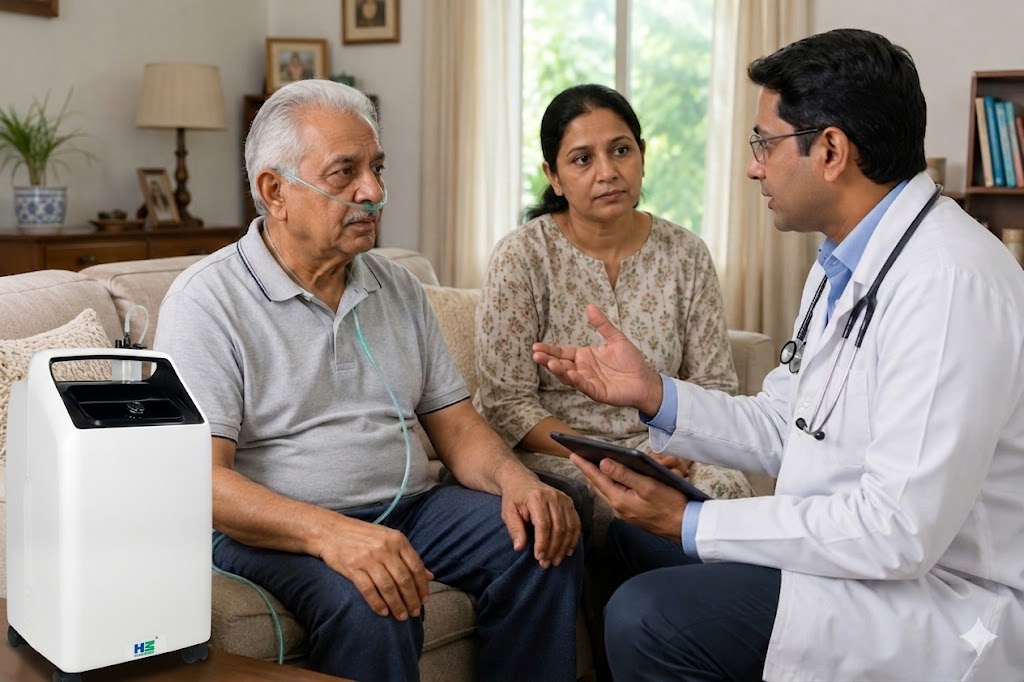
COPD oxygen prescription in India: GOLD 2024 LTOT, titration, and the risks of over-prescribing
COPD oxygen prescription in India.Long-term oxygen therapy remains one of only three interventions — alongside smoking cessation and, in selected patients, pulmonary rehabilitation or lung volume reduction — that extends survival in COPD.
The evidence anchoring this is four decades old, the thresholds have not moved materially, and yet in Indian practice, LTOT prescription is persistently miscalibrated. Patients who would benefit never get it. Patients who do get it are told to use it “whenever breathless” rather than ≥15 hours daily. Patients who do not meet criteria end up on 4 L/min continuously because a well-meaning prescriber did not want to refuse a distressed family. This article lays out what GOLD 2024 actually says, how to titrate, and where Indian prescribing habits drift off course.
The audience is the prescribing pulmonologist, the respiratory therapist, and the home-care dealer interpreting prescriptions that may or may not be fully specified.COPD oxygen prescription in India
The evidence — still NOTT and MRC
Two trials, both from 1980–1981, define modern LTOT and have never been displaced.COPD oxygen prescription in India.
The Nocturnal Oxygen Therapy Trial (NOTT) enrolled 203 COPD patients with documented arterial hypoxaemia (PaO₂ ≤55 mmHg, or 55–59 mmHg with cor pulmonale or polycythaemia) and randomised them to ~12 hours of nocturnal oxygen or ~18+ hours of continuous oxygen.
The continuous-oxygen group had approximately half the two-year mortality of the nocturnal-only group. The dose-response was the critical finding — more hours of oxygen, lower mortality.
The Medical Research Council trial enrolled 87 similarly severe COPD patients with chronic hypoxaemia and randomised them to 15 hours/day of oxygen or no oxygen. At 5 years, mortality was ~45% in the oxygen group vs ~67% in controls.
Combined, the findings have defined LTOT for four decades: in COPD patients with documented resting arterial hypoxaemia, supplemental oxygen reduces mortality; the effect is dose-dependent; the minimum duration producing benefit is approximately 15 hours/day.
The LOTT trial (2016) later tested oxygen in patients with moderate hypoxaemia — SpO₂ 89–93% or exertional desaturation — and found no mortality or hospitalisation benefit. The LOTT result did not dilute NOTT/MRC; it reinforced the threshold boundary. Oxygen helps severe resting hypoxaemia. It does not help moderate hypoxaemia.COPD oxygen prescription in India.
GOLD 2024 LTOT criteria
GOLD 2024 restates the LTOT indication (GOLD Report):COPD oxygen prescription in India
Prescribe LTOT for stable COPD patients with:COPD oxygen prescription in India
- PaO₂ ≤55 mmHg (SaO₂ ≤88%) at rest breathing room air, measured at least twice, three weeks or more apart, during a period of clinical stability;
or
- PaO₂ 55–60 mmHg (SaO₂ ~89%) in the presence of at least one of:
- Echocardiographic, ECG, or clinical evidence of cor pulmonale
- Polycythaemia (haematocrit > 55%, haemoglobin > 17 g/dL)
- Clinically significant pulmonary hypertension
- Peripheral oedema attributable to right heart failure
Stability conditions: not within six weeks of an exacerbation, on optimised medical therapy (long-acting bronchodilators, ICS where indicated per ABCD or ABE grouping), and not actively smoking.COPD oxygen prescription in India
The target of therapy is SaO₂ ≥ 90% (roughly SpO₂ 92%) at rest, during sleep, and during exertion. The minimum duration for mortality benefit is ≥15 hours/day, and most guidelines and textbooks favour 15–24 hours. Practically, the prescription translates as: wear oxygen during sleep, during quiet time at home, during any activity that brings on breathlessness, and during meals.
Lorem ipsum dolor sit amet, consectetur adipiscing elit.COPD oxygen prescription in India Ut elit tellus, luctus nec ullamcorper mattis, pulvinar dapibus leo.COPD oxygen prescription in India
Indian practice gaps
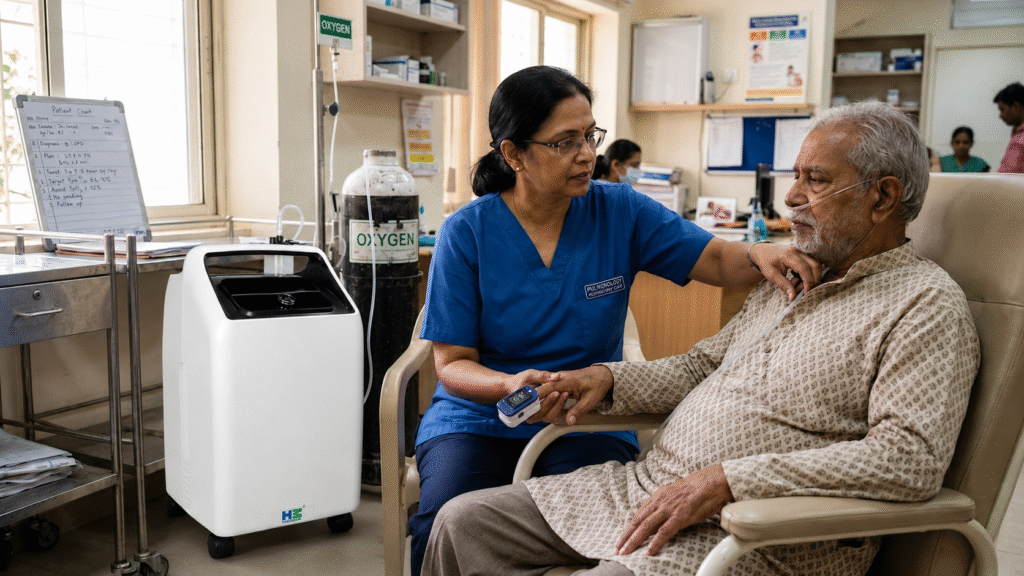
“4 L/min continuous” with no titration record. Often written by non-pulmonology prescribers under family pressure. Almost always over-prescription. The correct answer is 1–3 L/min titrated to SpO₂ 88–92%.
Sleep-hour-only oxygen for a resting-hypoxaemic patient. Often driven by concerns about mains electricity bills (oxygen concentrators at 5 LPM draw ~350 W, ~₹1,500–3,500/month depending on state tariff). The NOTT data specifically showed that 12 hours is not enough — mortality benefit requires ≥15 hours. Limiting a qualifying patient to sleep-hours only nullifies most of the benefit.
LTOT started on a single SpO₂ reading. GOLD requires two stable readings ≥3 weeks apart. Single-reading initiation happens in Indian OPD practice under time pressure; the prescription should still be reconfirmed within 90 days.
Concentrator size mismatch. A patient titrated to 2 L/min does not need a 10 LPM concentrator. Over-sizing is a common sales-driven error; the 10 LPM machines are louder, pull more mains current, and cost more to buy and run. Most COPD LTOT patients are appropriately served by a 5 LPM concentrator with its flowmeter in the 1–3 LPM range. 10 LPM units are for ILD, pulmonary hypertension, or CPAP-blend applications.
Ignoring CO₂ retention risk. A COPD patient with morning headache, daytime somnolence, or plethora should have ABG before LTOT. The concentrator titrated to SpO₂ 88–92% is a safe target; the concentrator cranked up to 4+ L/min without an ABG is not.
Contraindications and risks
Active smoking. Oxygen vigorously supports combustion. Facial burns, home fires, and deaths have been reported in patients smoking while on nasal cannula. Smoking cessation is a hard precondition for LTOT. In practice, the honest approach is to verify cessation (CO monitor, cotinine) before initiation, and to withdraw the prescription if smoking resumes.
Unstable coronary or cerebrovascular disease with CO₂ retention. Oxygen-induced hypercapnia in this subgroup is particularly risky. ABG-documented prescription and careful titration are mandatory.
Home fire risk. Indian household kitchens, incense, diya/agarbatti, and gas hobs are all ignition sources. Family education on keeping the cannula and tubing away from any flame is part of the prescription, not optional.
Electrical infrastructure. A stationary concentrator at 5 LPM uses ~350–450 W. Over 15+ hours/day, monthly electricity is ₹1,500–3,500 depending on state tariff and tier. The family’s ability to afford this should be assessed and discussed before the patient goes home with the device. Power-cut areas need a UPS or inverter sized for concentrator startup surge.
The ambulatory and exercise question
For the subgroup of COPD patients with resting PaO₂ above 60 mmHg but significant exertional desaturation, ambulatory oxygen is an option with honest caveats. The LOTT trial found no mortality or hospitalisation benefit from ambulatory/supplemental oxygen in moderate-hypoxaemia patients.
Some patients report symptomatic benefit — ability to walk further, shop, attend family events. Some patients find the equipment burden exceeds the benefit and stop carrying the device. The prescription should be issued with a realistic conversation about trial periods and expected outcomes.COPD oxygen prescription in India
Portable equipment choice matters here. Continuous-flow portables (5–6 kg, 2–3 LPM continuous, 4–5 hours battery) carry oxygen delivery that matches home concentrator flow. Pulse-dose portable concentrators (2–3 kg, 3–5 hour battery) deliver a bolus on inhalation trigger; the effective minute ventilation of oxygen is less than the numbered setting suggests, and patients with high respiratory rates or mouth-breathing patterns under-dose on pulse settings.
For exertional desaturators who walk fast enough to trigger 30+ breaths/min, pulse-dose often fails to maintain saturation
Clinical takeaway
Prescribe LTOT for COPD patients with PaO₂ ≤55 mmHg or SpO₂ ≤88% at rest, or PaO₂ 55–60 mmHg with cor pulmonale, polycythaemia, or pulmonary hypertension — measured in two stable readings at least three weeks apart. Target SpO₂ 88–92% at the lowest flow that achieves it, for ≥15 hours daily.
Most stable COPD LTOT patients are correctly prescribed at 1–3 L/min; 4+ L/min continuous is almost always over-prescription or a signal that the diagnosis is not uncomplicated COPD.
Ambulatory oxygen for exertional desaturators is an option with honest trial-period caveats, not a default.COPD oxygen prescription in India
Consult your pulmonologist before initiating or changing oxygen therapy; titration and CO₂-retention screening are not optional components of a safe prescription
Who needs LTOT for COPD?
COPD patients with low resting oxygen levels may need LTOT after proper medical assessment.
What is the ideal oxygen saturation target for COPD?
Most COPD patients should maintain SpO₂ around 88–92% as advised by a doctor.
Can oxygen be used whenever breathless?
No, oxygen should be used only as prescribed, not casually whenever breathlessness occurs.
How long should COPD patients use LTOT daily?
Eligible patients usually need oxygen for at least 15 hours per day.
Is too much oxygen dangerous for COPD patients?
Yes, excess oxygen can increase CO₂ retention and cause serious breathing complications.