
Counterfeit oxygen concentrators in India: how to spot them before you buy
counterfeit oxygen concentrators in India.The 2021 COVID-19 crisis flooded India with oxygen concentrators. Demand during April–June 2021 outstripped the licensed supply chain by an order of magnitude. The gap was filled by imports through non-standard channels, bulk-buying from unaudited Chinese OEMs, and a visible counterfeit segment that put “branded” stickers on unbranded units and pushed them through WhatsApp groups, Instagram ads, and small-dealer shelves. Many of those units are still in circulation in 2026 — resold, refurbished, or sitting in storerooms ready to re-enter the market during the next surge.counterfeit oxygen concentrators in India
This article covers how counterfeit concentrators continue to reach Indian buyers today, the telltale signs that a unit is not what the label claims, how to verify a serial number with the brand before payment, why “refurbished” is sometimes used to launder counterfeits, why third-party marketplaces are a riskier channel than authorised dealers, and how to report a counterfeit unit to CDSCO and consumer affairs authorities.counterfeit oxygen concentrators in India
The 2021 legacy that hasn’t gone away
During April–June 2021, Indian customs import records show a sharp spike in medical equipment imports, particularly concentrators and pulse oximeters. Not all of these units cleared through the regulated importer–distributor channel. A meaningful fraction entered through:
- Charity and donation channels that were not subject to the same commercial-import scrutiny. Units donated by foreign charities or NGOs sometimes entered without the full CDSCO registration process that a commercial import would require, and many of these units later re-entered the market second-hand.
- Individual / non-commercial imports — families who imported units for personal use and later sold them on.
- Bulk purchases by non-medical entities — resorts, offices, residential associations that bought in bulk for staff use, then resold when demand collapsed.
- Counterfeit manufacturers who put branded stickers on unbranded Chinese OEM units and sold them through distribution chains that did not verify provenance.
By 2022, as genuine supply recovered, prices fell, and these counterfeit and grey-market units were increasingly sold as “lightly used” or “refurbished” to clear inventory. As of 2024–2026, the ongoing risk segments are refurbished stock from the COVID era, grey-market imports through small dealers, and counterfeit or mis-branded units that continue to enter through unregulated e-commerce. (CDSCO)counterfeit oxygen concentrators in India.
Why counterfeits persist
Three structural factors keep the counterfeit segment alive:
Price pressure.
Authorised concentrators cost 15–30% more because they include CDSCO registration, authorised import, dealer support, warranty, and after-sales service. Grey-market units look cheaper, but buyers often mistake this safety and service cost as extra dealer profit.
Low buyer verification capability
Most first-time buyers cannot distinguish a genuine CE mark from a fake one, cannot verify a serial number against the manufacturer, and do not know to ask for a CDSCO import licence copy.
E-commerce intermediation
Third-party marketplaces historically allowed small sellers to list medical devices with limited verification. Regulatory pressure has tightened this somewhat, but small-seller channels remain a vector
Telltale signs — pricing
Price is the most reliable early indicator. Authorised-channel pricing for Indian-market concentrators sits in predictable bands:
- 5 LPM concentrator, mid-tier brand: ₹45,000–₹75,000 in 2026
- 5 LPM concentrator, premium brand: ₹65,000–₹95,000
- 10 LPM concentrator, mid-tier: ₹95,000–₹1,55,000
- 10 LPM concentrator, premium: ₹1,35,000–₹1,85,000
- Portable oxygen concentrator (POC) from an established brand: ₹1,85,000–₹3,50,000
A quote that sits materially below the bottom of the band — a branded 5 LPM at ₹30,000, a POC at ₹90,000 — is a strong signal. The unit may be counterfeit, may be grey-market, may be refurbished without disclosure, or may be end-of-life stock with minimal warranty support. None of these are what the buyer thinks they are paying for.counterfeit oxygen concentrators in India.
Telltale signs — the label
A careful label inspection catches many counterfeits before payment:
- Serial number format inconsistency. Each brand uses a specific serial-number format (letter-number pattern, length, check digit). A serial number that does not follow the brand’s format is either fake or from a different product line.
- Model number mismatch between carton, unit label, and manual. Counterfeits often cobble together packaging from multiple sources, and the numbers don’t agree.
- Missing or generic importer address. Authorised imports name a specific Indian importer with full address and CDSCO import licence number. Generic addresses (“India office”), PO boxes, or missing importer fields are red flags.
- CE mark without a four-digit Notified Body number. For Class IIa/IIb devices — which include all concentrators — a CE mark without the Notified Body number is invalid.
- Country-of-origin mismatch between the declared country and the languages on the manual, the manufacturer’s website address, or the power-cord specifications. A unit declared “Made in Germany” with Chinese-only text in the manual is not what it says.
- Mismatched brochure and unit spec. The brochure claims 93% oxygen concentration at 5 LPM; the unit label reads 90% at 5 LPM; the manual says 87%. Specifications should be consistent across all documentation.
- Missing or photoshopped CDSCO sticker. Some counterfeits include a “CDSCO approved” sticker that is non-standard, lacks a licence number, or shows signs of poor reproduction (pixelation, wrong colour, misspelling). Genuine CDSCO registration is documented by the import or manufacturing licence, not by a sticker.
- Missing authorised-dealer stamp and invoice. A legitimate dealer stamps the warranty card with their own shop stamp, date, and signature. Unstamped warranty cards, or cards with a blank dealer section, suggest the unit has not passed through an authorised sale.
Telltale signs — the unit itself
Beyond the labels, physical inspection:
- Build quality inconsistencies — mismatched plastic colours between front and rear panels, visible tool marks around screw holes, uneven panel gaps. Factory-fresh genuine units are generally uniform.
- Fasteners and seals — a tamper-evident seal that has been broken, replaced, or is obviously a sticker over a previously-opened panel suggests refurbishment without disclosure.
- Serial-number engraving or sticker quality — some brands laser-etch serial numbers directly onto chassis metal or moulded plastic. Counterfeits often use easily-removed stickers.
- Power cord and plug type — a unit declared for Indian market should carry a Type D or Type M Indian plug, not a Type A or a Chinese two-pin plug.
- Internal compressor brand (if visible through a vent) — major concentrator manufacturers use specific compressor brands (Gast, Thomas, Medo, Nitto Kohki, or their own proprietary compressor with a clearly-labelled brand). A no-brand compressor visible through the cooling vent is a signal.
Verifying the serial number with the brand
The single most useful pre-purchase check is a serial-number verification with the brand’s customer service. The sequence:
- Write down the full serial number from the unit label — not the carton label, which is easier to counterfeit.
- Identify the brand’s official customer service phone number or email from the manufacturer’s global website, not from a brochure the dealer provides (brochures can be reprinted).
- Contact the brand, provide the serial number, and ask: “Is this serial number registered for sale in India through your authorised importer?”
- A legitimate unit returns a confirmation with the registered importer’s name. That name should match the importer named on the unit’s label and invoice.
- A counterfeit or grey-market unit either returns “not in our database,” “that serial was shipped to [a different country],” or “that serial corresponds to a different product line.”
Reputable brands have customer-service teams that are explicitly staffed to handle counterfeit-verification queries. Chinese OEMs that do not sell directly to consumers may be less responsive; for those brands, verification via the authorised Indian importer is the equivalent step.counterfeit oxygen concentrators in India.
The patient’s pre-purchase checklist
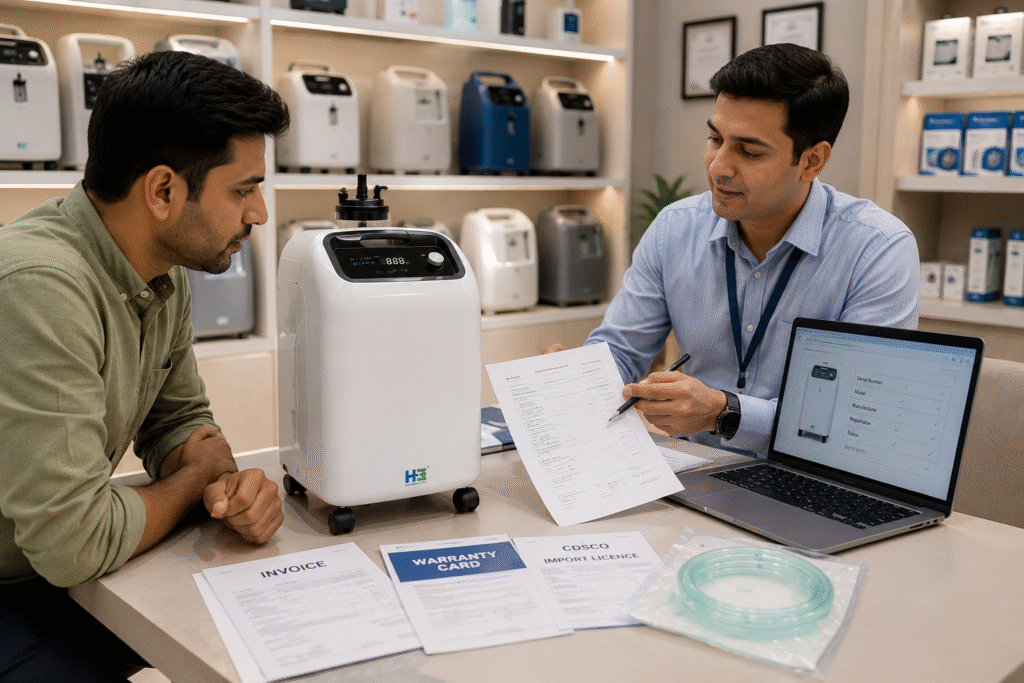
A practical checklist that applies to any concentrator purchase over ₹30,000:
- Is the dealer an authorised dealer for this brand? (Check the brand’s official website.)
- Can the dealer produce the CDSCO import licence copy (Form MD-15) for this specific model?
- Does the price sit within the expected authorised-channel band for this model?
- Does the serial number on the unit match the invoice, warranty card, and carton?
- Has the brand confirmed the serial number as registered for India?
- Is the CE mark accompanied by a four-digit Notified Body number, and does that number resolve on NANDO?
- Does the warranty card carry the dealer’s stamp with a verifiable shop address?
- Does the packaging and manual come in the language consistent with the declared country of manufacture?
- Does the unit’s physical build show uniform finish, no tool marks, no broken tamper-evident seals?
Every “no” on this list is a caution; multiple “no” answers together mean the unit should not be purchased at that price from that source.counterfeit oxygen concentrators in India.
How can buyers identify a fake oxygen concentrator?
Buyers should check the price, serial number, CDSCO licence, warranty card, importer details, and authorised dealer status before purchase.
Why are authorised oxygen concentrators costlier?
They include regulatory approval, genuine warranty, verified import, dealer accountability, and after-sales service.
Is a very cheap oxygen concentrator safe to buy?
No, a very low price can indicate a counterfeit, grey-market, refurbished, or unsupported device.
What is the safest way to verify an oxygen concentrator?
Contact the official brand or authorised importer and verify the serial number before payment.
Why should patients avoid unknown online sellers?
Unknown sellers may provide fake products, weak warranty support, and no reliable after-sales service.